Description
Chemical Identity
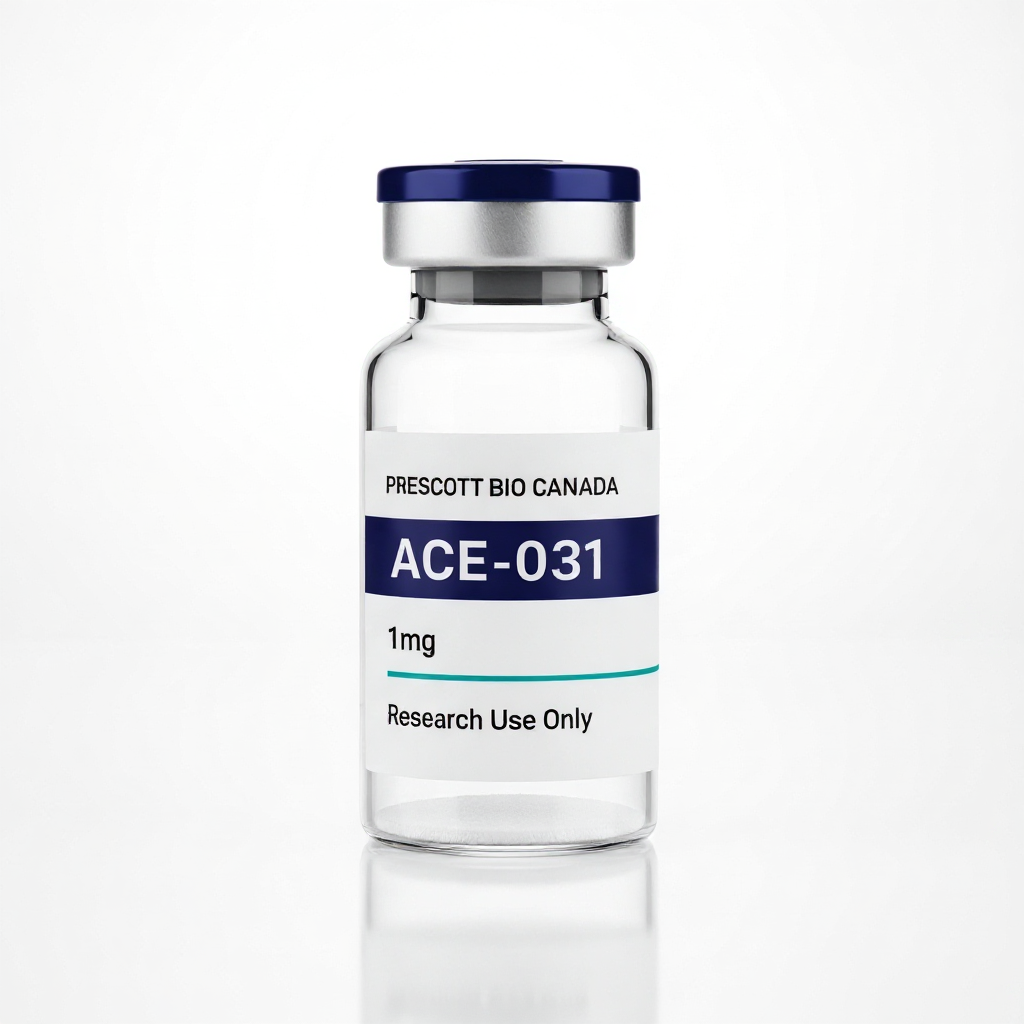
ACE-031 analytical reference compound. Molecular weight 130000 Da. Also known as: ActRIIB-Fc, ActRIIB-IgG1 Fc, Activin Receptor Type IIB Decoy. Research status: Discontinued.
Research Overview
ACE-031 is a soluble form of the activin receptor type IIB (ActRIIB) fused to the Fc portion of human IgG1 antibody. It acts as a decoy receptor that traps myostatin and related TGF-beta superfamily ligands, preventing them from binding to endogenous receptors and thereby promoting muscle growth. Clinical development was halted in 2013 due to safety concerns including epistaxis and telangiectasias observed in a Phase 2 trial in boys with DMD.
By removing the myostatin inhibitory signal, ACE-031 shifts the balance between muscle protein synthesis and degradation toward net anabolism. This results in increased muscle fiber size (hypertrophy), enhanced satellite cell activation and differentiation, increased expression of myogenic transcription factors (MyoD, myogenin), and reduced expression of the ubiquitin-proteasome pathway components that mediate muscle protein breakdown.
In addition to promoting muscle growth, myostatin pathway inhibition has been shown to reduce adipose tissue accumulation. This dual effect on body composition (increasing lean mass while decreasing fat mass) was observed in clinical studies with ACE-031 and represents an attractive therapeutic profile for metabolic diseases.
Key published studies on ACE-031 include: “Myostatin inhibitor ACE-031 treatment of ambulatory boys with Duchenne muscular dystrophy: Results of a randomized, placebo-controlled clinical trial” (Muscle and Nerve, 2017); “Safety, tolerability, pharmacokinetics, and pharmacodynamics of ACE-031 in healthy volunteers” (Muscle and Nerve, 2013). These findings should be interpreted within the context of the experimental models and conditions described in each publication.
Research Context
ACE-031 is a recombinant fusion protein that consists of the extracellular domain of human activin receptor type IIB (ActRIIB) fused to the Fc portion of human immunoglobulin G1 (IgG1). It was developed by Acceleron Pharma as a therapeutic agent for conditions characterized by muscle wasting, with the primary clinical target being Duchenne muscular dystrophy (DMD). The compound functions as a soluble decoy receptor that intercepts and neutralizes myostatin and other members of the TGF-beta superfamily before they can bind to their endogenous cell-surface receptors, effectively removing the molecular brake on muscle growth.
The development of ACE-031 was grounded in one of the most compelling biological discoveries of the late 20th century: the identification of myostatin (GDF-8) as a negative regulator of skeletal muscle mass. Animals and rare humans with natural myostatin loss-of-function mutations exhibit dramatic muscular hypertrophy, demonstrating that inhibiting the myostatin pathway could be a powerful strategy for treating muscle wasting diseases.
Myostatin, formally known as growth differentiation factor 8 (GDF-8), is a member of the TGF-beta superfamily of secreted growth factors. It is produced primarily by skeletal muscle cells and acts in an autocrine and paracrine fashion to inhibit muscle cell proliferation and differentiation. Under normal conditions, myostatin serves as a natural limiter of muscle mass, preventing excessive muscle growth.
Specifications
| Sequence | Recombinant ActRIIB-Fc fusion protein |
| Molecular Weight | 130000 Da |
| Purity | >=98% (HPLC) |
| Appearance | White to off-white lyophilized powder |
| Format | Lyophilized powder, sterile filtered |
| Solubility | Soluble in bacteriostatic water, sterile water, or normal saline |
| Storage | Store at -20°C (lyophilized). Reconstituted: 2-8°C, use within 30 days |
| Shipping | Ambient temperature (stable in lyophilized form) |
Each lot is accompanied by a Certificate of Analysis (COA) documenting purity, identity, and endotoxin testing results.
Research Applications
ACE-031 reference compound has been documented in the published scientific literature across the following in vitro and preclinical research areas:
- Myostatin Biology
- The Decoy Receptor Strategy
- Ligand Promiscuity
- Muscle Hypertrophy
- Anti-Adipogenic Effects
- Bone Effects
- Phase 1 — Healthy Volunteers
- Phase 2 — Duchenne Muscular Dystrophy
Researchers are advised to consult the primary literature for detailed experimental protocols, concentrations, and conditions relevant to their specific area of investigation involving ACE-031.
Storage and Handling
ACE-031 is supplied as a lyophilized powder and should be stored at -20°C upon receipt for long-term stability. Protect from light, moisture, and repeated temperature fluctuations. Allow the sealed vial to equilibrate to room temperature before opening to prevent condensation and moisture absorption.
For reconstitution, add sterile water or an appropriate buffer slowly along the vial wall to avoid foaming. Gently swirl to dissolve — do not vortex. Reconstituted ACE-031 solutions should be stored at 2-8°C and used within 30 days. Aliquoting is recommended to minimize freeze-thaw cycles. Consult the Safety Data Sheet (SDS) for detailed handling and disposal guidance.
For laboratory research use only (in vitro). Not for human or animal use. Not for diagnostic, therapeutic, or clinical purposes. ACE-031 is supplied as an analytical reference compound for use by qualified research personnel at accredited institutions. Prescott Bio Canada does not provide guidance on administration, dosing, or use in living organisms.