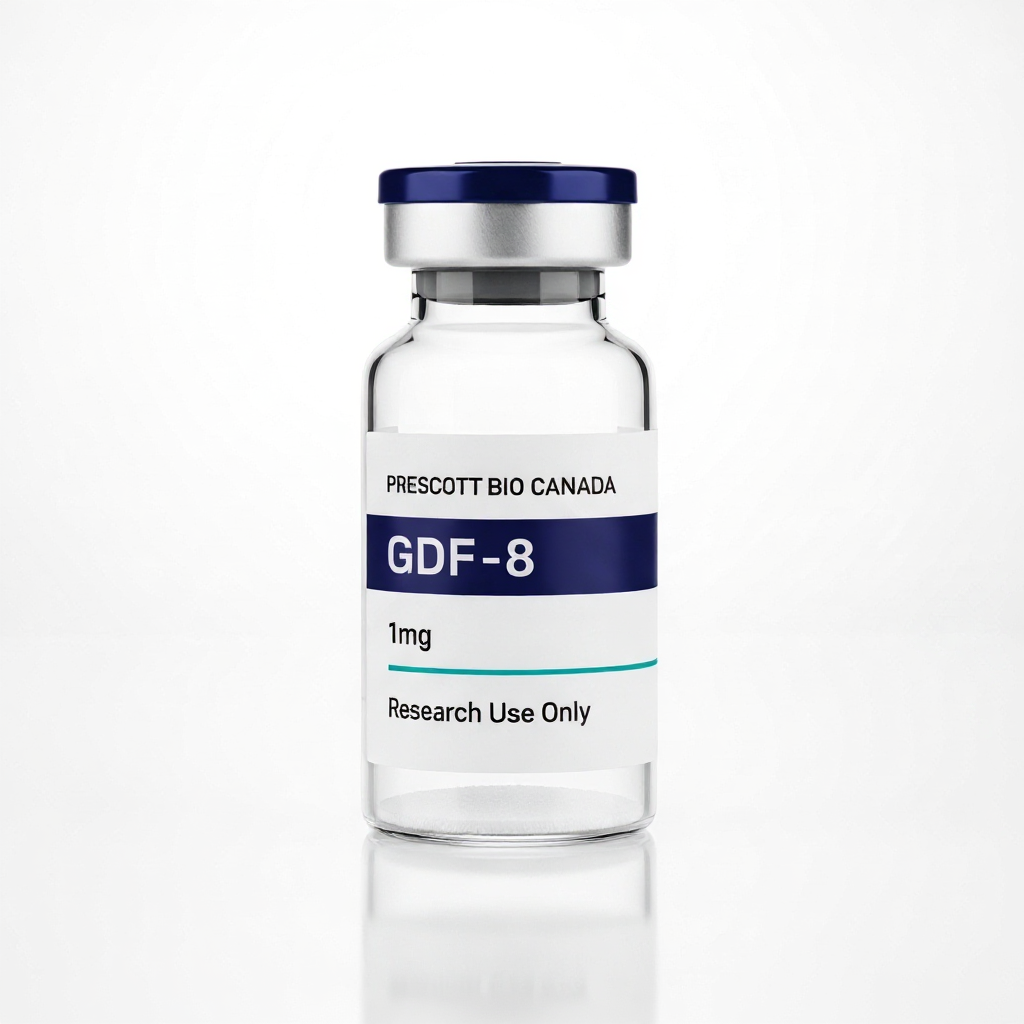
Description
Chemical Identity
GDF-8, formally known as Myostatin (Growth Differentiation Factor 8), is a member of the TGF-beta superfamily of secreted growth factors with the molecular formula C1237H1927N355O374S10 and an approximate molecular weight of 25,000 Da as a dimer (12,500 Da per monomer; CAS number 346693-49-8). GDF-8 is produced primarily by skeletal muscle cells and acts as the most potent known negative regulator of skeletal muscle mass.
The discovery of myostatin in 1997 by Se-Jin Lee and colleagues at Johns Hopkins University represented a landmark in muscle biology. Animals with natural myostatin loss-of-function mutations exhibit dramatic muscular hypertrophy, including the Belgian Blue and Piedmontese cattle breeds (“double-muscling” phenotype). The mature myostatin protein is 100% conserved across all examined mammalian species, underscoring its fundamental biological importance.
| Property | Value |
|---|---|
| Molecular Formula | C1237H1927N355O374S10 |
| Molecular Weight | ~25,000 Da (dimer) |
| CAS Number | 346693-49-8 |
| Structure | Disulfide-linked homodimer; TGF-beta superfamily member |
| Research Status | Preclinical (target protein for inhibitor development) |
Research Overview
GDF-8 has been one of the most actively studied therapeutic targets in musculoskeletal research since its identification. Myostatin signals through binding to the activin receptor type IIB (ActRIIB) on muscle cell surfaces, activating SMAD2/SMAD3 transcription factors that suppress muscle protein synthesis and promote muscle protein degradation. Inhibiting this pathway has become a major strategy for treating muscle wasting conditions.
The biological significance of GDF-8 is demonstrated by natural loss-of-function mutations across species. In addition to cattle breeds, a rare human case was documented in the New England Journal of Medicine (2004), describing a child with a myostatin mutation who exhibited extraordinary muscular development, providing direct human evidence for myostatin’s role in regulating muscle mass.
Key areas of published research include:
- Muscular Dystrophy and Muscle Wasting: GDF-8 inhibition is a major therapeutic target for Duchenne muscular dystrophy, sarcopenia, and cachexia. Multiple inhibitor strategies have been developed including anti-myostatin antibodies, decoy receptors (ACE-031), and follistatin-based approaches. A Phase I/II trial of the anti-myostatin antibody MYO-029 in adult muscular dystrophy patients demonstrated safety but limited efficacy signals.
- Body Composition and Metabolic Research: Myostatin knockout mice exhibit approximately 2-fold increases in skeletal muscle mass with concurrent reductions in adipose tissue, establishing GDF-8 as a regulator of both muscle and fat metabolism. This dual effect has implications for metabolic disease research.
- Next-Generation Inhibitor Development: The field has evolved from broad ActRIIB decoy receptor approaches toward more selective myostatin-specific inhibitors to improve safety profiles, informed by clinical experience with compounds like ACE-031.
GDF-8 reference standard is used in research as both the target protein for inhibitor screening and as a tool for studying TGF-beta superfamily signaling in muscle biology.
Specifications
All GDF-8 supplied by Prescott Bio Canada is manufactured to research-grade standards.
| Specification | Detail |
|---|---|
| Purity | >98% (HPLC) |
| Form | Lyophilized powder |
| Appearance | White to off-white powder |
| Storage (lyophilized) | -20°C, protected from light |
| Storage (reconstituted) | 2-8°C, use within 30 days |
| Solubility | Soluble in sterile water or appropriate buffer |
Each vial is accompanied by a Certificate of Analysis (COA) documenting purity, identity, and endotoxin testing.
Research Applications
GDF-8 is supplied exclusively for in vitro and in vivo laboratory research. Published experimental applications include:
- Myostatin pathway signaling and SMAD2/SMAD3 transcription factor research
- Muscle wasting disease model development and inhibitor screening assays
- TGF-beta superfamily receptor binding and selectivity studies
- Body composition research examining muscle-fat metabolism crosstalk
- Muscular dystrophy, sarcopenia, and cachexia therapeutic development
- ActRIIB receptor pharmacology and decoy receptor competition assays
Researchers should consult the primary literature and institutional review protocols before designing experiments with GDF-8.
Storage and Handling
Lyophilized powder: Store at -20°C in the original sealed vial, protected from light and moisture. Under these conditions, GDF-8 maintains stability for up to 24 months.
Reconstituted solution: Reconstitute with sterile water or appropriate buffer to the desired concentration. Store reconstituted GDF-8 at 2-8°C and use within 30 days. Avoid repeated freeze-thaw cycles.
Handling precautions: This product is intended for research use only (RUO). Not for human or veterinary diagnostic or therapeutic use. Handle using standard laboratory safety practices including appropriate PPE.