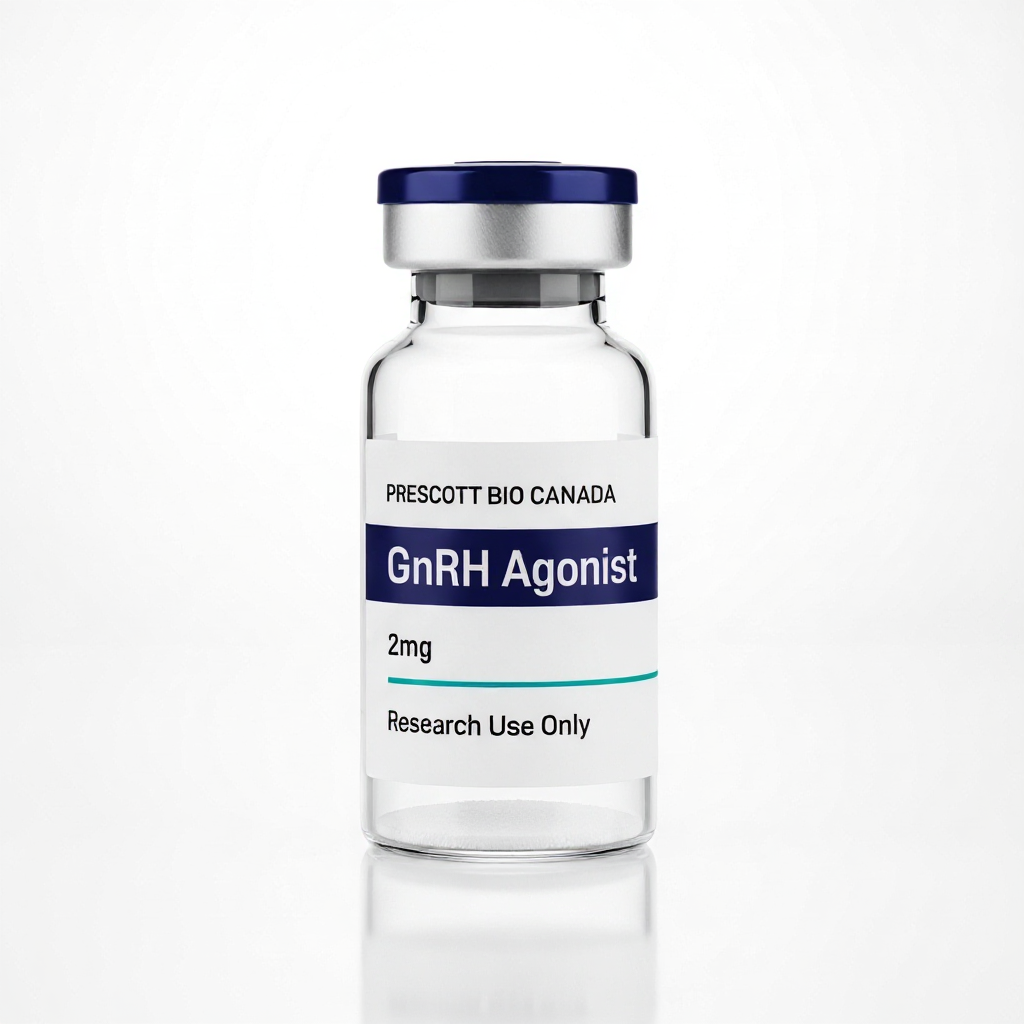
Description
Chemical Identity
GnRH Agonist Decapeptide is a synthetic decapeptide analog of gonadotropin-releasing hormone (GnRH) with the molecular formula C64H82N18O13 and a molecular weight of approximately 1311.45 Da. Also known as triptorelin in the research literature, this peptide features a D-tryptophan substitution at position 6 of the native GnRH sequence, which confers enhanced receptor binding affinity and resistance to enzymatic degradation. The amino acid sequence is pGlu-His-Trp-Ser-Tyr-D-Trp-Leu-Arg-Pro-Gly-NH2.
GnRH Agonist Decapeptide is also known by the following research designations: Triptorelin, Trelstar, Decapeptyl, Gonapeptyl, D-Trp6-GnRH.
| Property | Value |
|---|---|
| Molecular Formula | C64H82N18O13 |
| Molecular Weight | 1311.45 Da |
| CAS Number | 57773-63-4 |
| Sequence | pGlu-His-Trp-Ser-Tyr-D-Trp-Leu-Arg-Pro-Gly-NH2 |
| Research Status | FDA Approved |
Research Overview
GnRH Agonist Decapeptide, widely referenced as triptorelin in published literature, has been investigated in numerous randomized controlled trials and meta-analyses spanning oncology, reproductive medicine, and endocrinology. The primary mechanism of action involves a characteristic biphasic response: an initial stimulatory phase (flare) of 1-2 weeks followed by pituitary GnRH receptor desensitization, downregulation, and suppression of gonadotropin (LH and FSH) secretion, resulting in castrate or hypogonadal sex steroid levels.
Key areas of published research include:
- Prostate Cancer: Multiple randomized controlled trials have demonstrated that GnRH Agonist Decapeptide effectively achieves and maintains castrate testosterone levels across all depot formulation durations (1-month, 3-month, and 6-month). A head-to-head comparison with another GnRH agonist confirmed equivalent testosterone suppression and comparable safety profiles. Systematic reviews support its use in androgen deprivation therapy as a cornerstone of advanced prostate cancer management.
- Ovarian Function Preservation: The PROMISE-GIM6 randomized trial demonstrated that GnRH Agonist Decapeptide significantly reduced the incidence of premature ovarian failure after chemotherapy in premenopausal breast cancer patients (8.9% vs 25.9% with chemotherapy alone). A subsequent meta-analysis of individual patient-level data confirmed that GnRH agonists reduced the risk of premature ovarian failure (OR 0.36, 95% CI 0.23-0.57) with significantly higher pregnancy rates and no negative impact on cancer prognosis.
- Reproductive and Endocrine Applications: Published research supports efficacy in endometriosis management through estrogen suppression, central precocious puberty treatment to preserve growth potential, uterine fibroid size reduction (30-60%) prior to surgery, and prevention of premature LH surges in assisted reproductive technology protocols.
GnRH Agonist Decapeptide has FDA approval for advanced prostate cancer, endometriosis, central precocious puberty, and uterine fibroids. It has decades of clinical use across millions of patients worldwide with a well-characterized safety profile.
Specifications
All GnRH Agonist Decapeptide supplied by Prescott Bio Canada is manufactured to research-grade standards.
| Specification | Detail |
|---|---|
| Purity | >98% (HPLC) |
| Form | Lyophilized powder |
| Appearance | White to off-white powder |
| Storage (lyophilized) | -20°C, protected from light |
| Storage (reconstituted) | 2-8°C, use within 30 days |
| Solubility | Soluble in bacteriostatic water, sterile water, or normal saline |
Each vial is accompanied by a Certificate of Analysis (COA) documenting purity, identity, and endotoxin testing.
Research Applications
GnRH Agonist Decapeptide is supplied exclusively for in vitro and in vivo laboratory research. Published experimental applications include:
- Investigation of hypothalamic-pituitary-gonadal axis desensitization mechanisms
- Assessment of GnRH receptor downregulation and gonadotropin suppression kinetics
- Study of androgen deprivation effects on hormone-dependent tumor models
- Evaluation of ovarian function preservation during gonadotoxic treatment protocols
- Analysis of depot formulation pharmacokinetics and sustained-release profiles
Researchers should consult the primary literature and institutional review protocols before designing experiments with GnRH Agonist Decapeptide.
Storage and Handling
Lyophilized powder: Store at -20°C in the original sealed vial, protected from light and moisture. Under these conditions, GnRH Agonist Decapeptide maintains stability for up to 24 months.
Reconstituted solution: Reconstitute with bacteriostatic water or sterile water to the desired concentration. Store reconstituted GnRH Agonist Decapeptide at 2-8°C and use within 30 days. Avoid repeated freeze-thaw cycles.
Handling precautions: This product is intended for research use only (RUO). Not for human or veterinary diagnostic or therapeutic use. Handle using standard laboratory safety practices including appropriate PPE.