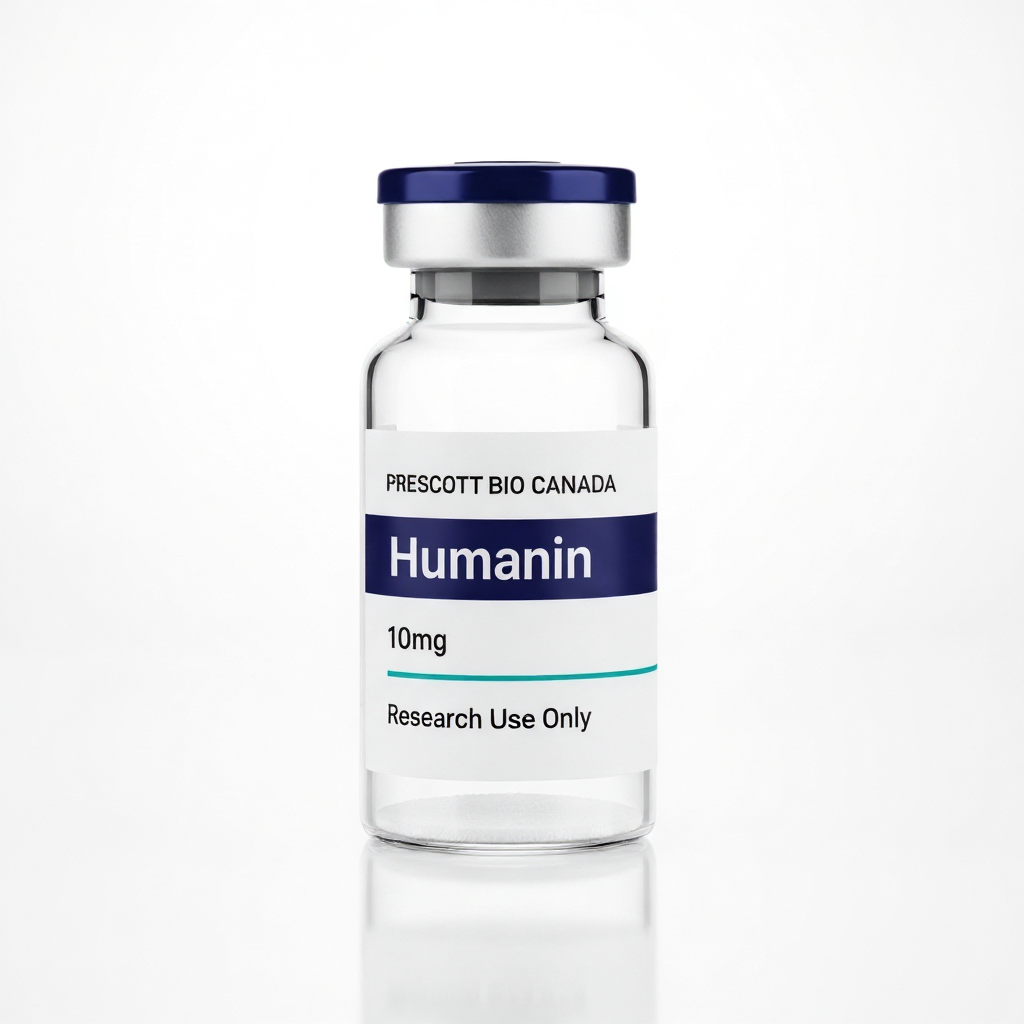
Description
Chemical Identity
Humanin is a 24-amino acid mitochondrial-derived peptide with the molecular formula C119H204N34O33S2 and a molecular weight of approximately 2,687.3 Da. Encoded by the MT-RNR2 gene within the mitochondrial 16S ribosomal RNA, Humanin was discovered in 2001 from neurons that survived Alzheimer’s disease neurodegeneration, making it the first identified mitochondrial-derived peptide (MDP). The amino acid sequence is MAPRGFSCLLLLTSEIDLPVKRRA. The peptide adopts a partially helical structure in solution with a central hydrophobic domain critical for biological activity.
Humanin is also known by the following designations: HN, HNG (S14G-Humanin, a potent analog), and MT-RNR2.
| Property | Value |
|---|---|
| Molecular Formula | C119H204N34O33S2 |
| Molecular Weight | 2,687.3 Da |
| CAS Number | 330936-69-1 |
| Sequence | MAPRGFSCLLLLTSEIDLPVKRRA (24 aa) |
| Research Status | Preclinical |
Research Overview
Humanin has been investigated in preclinical models of neurodegeneration, aging, metabolic disease, and cytoprotection. The primary mechanism of action involves two parallel pathways. Extracellularly, Humanin binds a tripartite receptor complex comprising CNTFR-alpha, WSX-1, and gp130, activating downstream JAK2/STAT3 and PI3K/AKT signaling cascades that promote cell survival and suppress apoptosis. Intracellularly, Humanin directly binds the pro-apoptotic proteins Bax and BID, preventing mitochondrial outer membrane permeabilization and blocking the intrinsic apoptotic pathway.
Key areas of published research include:
- Neuroprotection in Alzheimer’s Models: Humanin was originally identified from neurons surviving Alzheimer’s disease neurodegeneration. In cell culture and animal models, Humanin protects neurons against amyloid-beta toxicity, and the S14G-Humanin analog (HNG) demonstrates approximately 1,000-fold greater potency than wild-type Humanin. The neuroprotective effect extends to multiple Alzheimer’s-relevant insults including oxidative stress and excitotoxicity.
- Anti-Apoptotic and Cytoprotective Activity: Humanin demonstrates broad cytoprotective effects beyond neuronal tissue, protecting cardiac cells, endothelial cells, retinal pigment epithelial cells, and pancreatic beta cells from apoptotic stimuli in preclinical models. The mechanism involves direct interaction with Bax to prevent its translocation to mitochondria and subsequent cytochrome c release.
- Metabolic Regulation: Preclinical studies have demonstrated that Humanin improves insulin sensitivity and glucose homeostasis in animal models. Circulating Humanin levels decline with age and correlate with metabolic health parameters, suggesting a role for mitochondrial-derived peptide signaling in age-related metabolic dysfunction.
The current evidence base consists entirely of preclinical in vitro and animal model studies. No human clinical trials have been initiated. Humanin’s short half-life in circulation (minutes for native peptide) has driven development of more stable analogs including S14G-Humanin (HNG).
Specifications
All Humanin supplied by Prescott Bio Canada is manufactured to research-grade standards.
| Specification | Detail |
|---|---|
| Purity | >98% (HPLC) |
| Form | Lyophilized powder |
| Appearance | White to off-white powder |
| Storage (lyophilized) | -20°C, protected from light |
| Storage (reconstituted) | 2-8°C, use within 30 days |
| Solubility | Soluble in bacteriostatic water, sterile water, or normal saline |
Each vial is accompanied by a Certificate of Analysis (COA) documenting purity, identity, and endotoxin testing.
Research Applications
Humanin is supplied exclusively for in vitro and in vivo laboratory research. Published experimental applications include:
- Investigation of mitochondrial-derived peptide biology and MT-RNR2 gene expression regulation
- Study of anti-apoptotic mechanisms involving Bax/BID interaction and mitochondrial membrane integrity
- Examination of CNTFR/WSX-1/gp130 receptor complex signaling and JAK2/STAT3 pathway activation
- Research into age-related decline of circulating mitochondrial-derived peptides and metabolic consequences
Researchers should consult the primary literature and institutional review protocols before designing experiments with Humanin.
Storage and Handling
Lyophilized powder: Store at -20°C in the original sealed vial, protected from light and moisture. Under these conditions, Humanin maintains stability for up to 24 months.
Reconstituted solution: Reconstitute with bacteriostatic water or sterile water to the desired concentration. Store reconstituted Humanin at 2-8°C and use within 30 days. Avoid repeated freeze-thaw cycles.
Handling precautions: This product is intended for research use only (RUO). Not for human or veterinary diagnostic or therapeutic use. Handle using standard laboratory safety practices including appropriate PPE.