Description
Chemical Identity
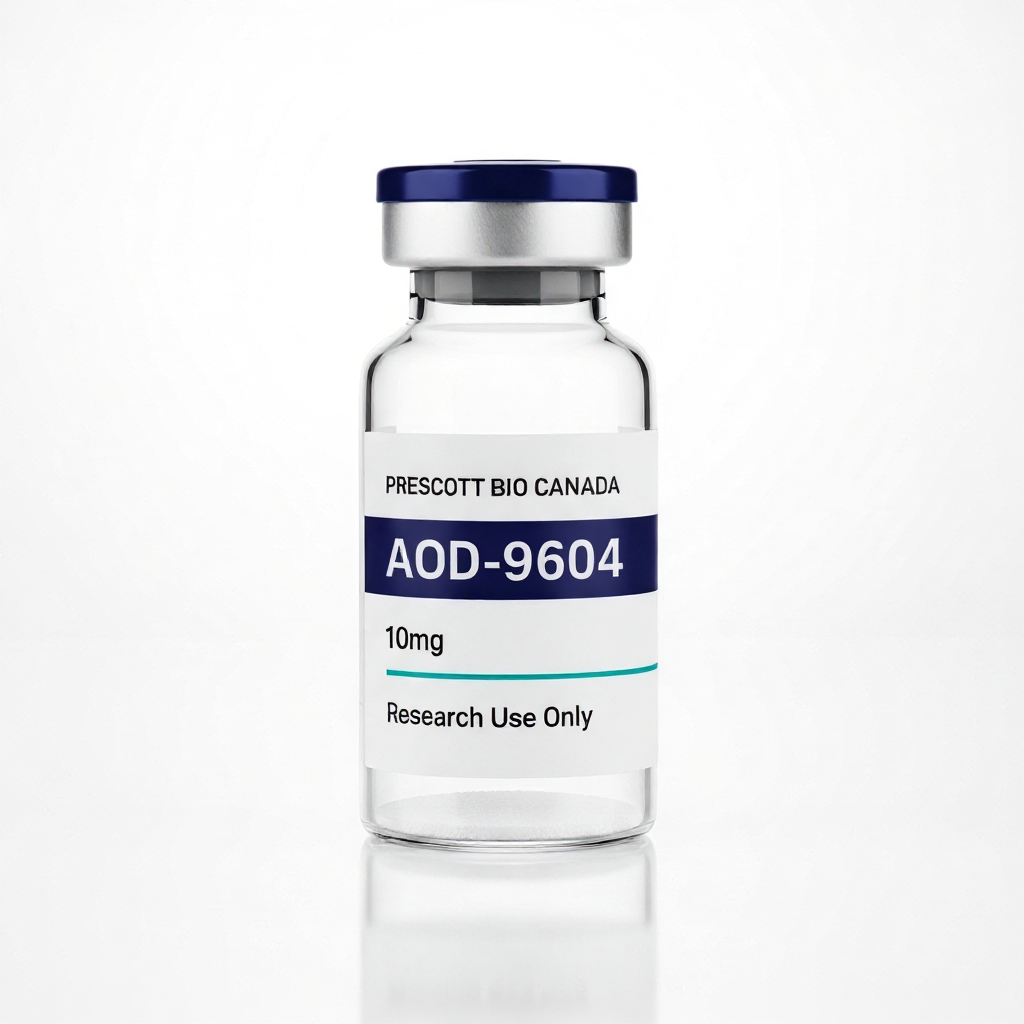
AOD-9604 analytical reference compound. Molecular weight 1815.12 Da. Also known as: Anti-Obesity Drug 9604, hGH Fragment 176-191, AOD9604. Research status: Discontinued.
Research Overview
AOD-9604 is a synthetic 16-amino acid peptide derived from the C-terminal region of human growth hormone (residues 176-191) with an N-terminal tyrosine substitution. It was designed to retain the lipolytic (fat-burning) properties of hGH while eliminating the growth-promoting and diabetogenic effects. Despite completing six human clinical trials involving over 900 participants, AOD-9604 failed to achieve statistically significant weight loss in its largest Phase IIb trial and development was terminated in 2007. It is now studied for potential cartilage repair applications.
AOD-9604’s primary pharmacological effect is the stimulation of lipolysis (breakdown of stored fat). The proposed mechanism involves:
1. Beta-3 adrenergic receptor upregulation: Chronic treatment with AOD-9604 increases the expression of beta-3 adrenergic receptors (beta-3 AR) on adipocytes. While AOD-9604 does not act directly through the beta-3 AR, the increased receptor expression may enhance lipolytic sensitivity to endogenous catecholamines. Studies in beta-3 AR knockout mice showed that the weight loss effects of AOD-9604 were abolished, confirming the importance of this pathway.
Key published studies on AOD-9604 include: “Effect of intra-articular injection of AOD9604 with or without hyaluronic acid in rabbit osteoarthritis model” (Annals of Clinical and Laboratory Science, 2015); “Increase of fat oxidation and weight loss in obese mice caused by chronic treatment with human growth hormone or a modified C-terminal fragment” (International Journal of Obesity, 2001); “The effects of human GH and its lipolytic fragment (AOD9604) on lipid metabolism following chronic treatment in obese mice and beta(3)-AR knock-out mice” (Endocrinology, 2001). These findings should be interpreted within the context of the experimental models and conditions described in each publication.
Research Context
AOD-9604 (Anti-Obesity Drug 9604) is a synthetic peptide corresponding to residues 176-191 of the C-terminal region of human growth hormone (hGH) with a tyrosine residue substituted at the N-terminus in place of the native phenylalanine. This 16-amino acid peptide was designed to isolate the lipolytic (fat-burning) activity of growth hormone from its growth-promoting, diabetogenic, and anabolic effects. The full amino acid sequence is Tyr-Leu-Arg-Ile-Val-Gln-Cys-Arg-Ser-Val-Glu-Gly-Ser-Cys-Gly-Phe, with an intramolecular disulfide bond between the two cysteine residues (Cys7 and Cys14).
AOD-9604 was developed by Metabolic Pharmaceuticals Ltd. (later Calzada Ltd.) in Australia during the 1990s, building on earlier research that identified the C-terminal domain of hGH as the region responsible for the hormone’s lipolytic activity. The molecular formula is C78H123N23O23S2 with a molecular weight of 1815.12 Da and CAS number 221231-10-3.
The peptide underwent an extensive clinical development program, completing six human clinical trials involving over 900 participants. However, AOD-9604 failed to demonstrate statistically significant weight loss in its largest Phase IIb trial, and pharmaceutical development was terminated in 2007. Despite this clinical failure for the obesity indication, the peptide has attracted renewed interest for potential applications in cartilage repair and osteoarthritis.
Specifications
| Sequence | Tyr-Leu-Arg-Ile-Val-Gln-Cys-Arg-Ser-Val-Glu-Gly-Ser-Cys-Gly-Phe |
| Molecular Weight | 1815.12 Da |
| Molecular Formula | C78H123N23O23S2 |
| CAS Number | 221231-10-3 |
| Purity | >=98% (HPLC) |
| Appearance | White to off-white lyophilized powder |
| Format | Lyophilized powder, sterile filtered |
| Solubility | Soluble in bacteriostatic water, sterile water, or normal saline |
| Storage | Store at -20°C (lyophilized). Reconstituted: 2-8°C, use within 30 days |
| Shipping | Ambient temperature (stable in lyophilized form) |
Each lot is accompanied by a Certificate of Analysis (COA) documenting purity, identity, and endotoxin testing results.
Research Applications
AOD-9604 reference compound has been documented in the published scientific literature across the following in vitro and preclinical research areas:
- Lipolytic Activity
- Separation from hGH Effects
- Cartilage Repair Potential
- Preclinical Studies
- Clinical Trials
- Post-Clinical Development
- Cartilage and Joint Health
- Metabolic Health
Researchers are advised to consult the primary literature for detailed experimental protocols, concentrations, and conditions relevant to their specific area of investigation involving AOD-9604.
Storage and Handling
AOD-9604 is supplied as a lyophilized powder and should be stored at -20°C upon receipt for long-term stability. Protect from light, moisture, and repeated temperature fluctuations. Allow the sealed vial to equilibrate to room temperature before opening to prevent condensation and moisture absorption.
For reconstitution, add sterile water or an appropriate buffer slowly along the vial wall to avoid foaming. Gently swirl to dissolve — do not vortex. Reconstituted AOD-9604 solutions should be stored at 2-8°C and used within 30 days. Aliquoting is recommended to minimize freeze-thaw cycles. Consult the Safety Data Sheet (SDS) for detailed handling and disposal guidance.
For laboratory research use only (in vitro). Not for human or animal use. Not for diagnostic, therapeutic, or clinical purposes. AOD-9604 is supplied as an analytical reference compound for use by qualified research personnel at accredited institutions. Prescott Bio Canada does not provide guidance on administration, dosing, or use in living organisms.