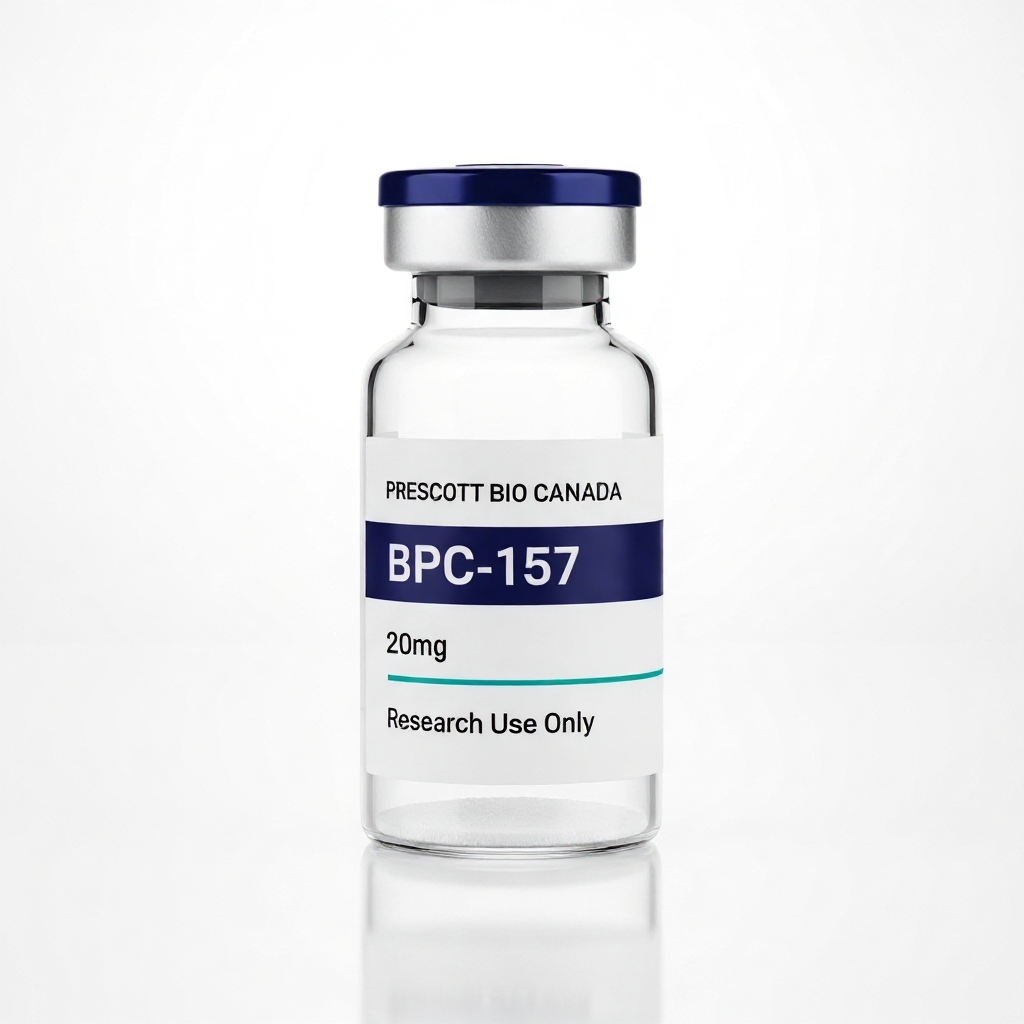
Description
Chemical Identity
BPC-157 analytical reference compound. Molecular weight 1419.53 Da. Also known as: Body Protection Compound-157, Pentadecapeptide BPC 157, PL-14736. Research status: Preclinical.
Research Overview
BPC-157 (Body Protection Compound-157) is a synthetic pentadecapeptide consisting of 15 amino acids, derived from a protective protein found in human gastric juice. It has been extensively studied in preclinical models for tissue healing across gastrointestinal, musculoskeletal, neurological, and vascular systems. BPC-157 acts primarily through the VEGFR2-Akt-eNOS axis to promote angiogenesis and tissue repair, with additional effects on nitric oxide signaling, growth hormone receptor expression, and FAK-paxillin cell migration pathways. Human clinical data remains limited to early-phase studies. As of February 2026, BPC-157 has been reclassified to allow compounding pharmacy access with a physician prescription.
BPC-157 is a pleiotropic peptide with predominantly endothelial and cytoprotective actions. Rather than binding a single canonical receptor, BPC-157’s effects converge on angiogenic signaling, nitric oxide (NO) modulation, cytoskeletal/migratory programs, and barrier stabilization. A broad receptor binding screen reported no direct pharmacological affinity for classical neurotransmitter receptor families, supporting an indirect or upstream modulatory mode of action.
The primary signaling pathway through which BPC-157 promotes tissue healing involves vascular endothelial growth factor (VEGF) and its receptor system:
The gastrointestinal tract is the origin tissue for BPC-157 and the most extensively studied application:
Key published studies on BPC-157 include: “Pentadecapeptide BPC 157 reduces bleeding time and thrombocytopenia after amputation in rats treated with heparin, warfarin or aspirin” (Blood Coagulation & Fibrinolysis, 2015); “Pentadecapeptide BPC 157 enhances the growth hormone receptor expression in human tendon fibroblasts” (Molecules, 2014); “Stable gastric pentadecapeptide BPC 157 heals cysteamine-colitis and colon-colon anastomosis and counteracts cuprizone brain injuries and motor disability” (Journal of Physiology and Pharmacology, 2013). These findings should be interpreted within the context of the experimental models and conditions described in each publication.
Research Context
BPC-157 (Body Protection Compound-157) is a synthetic pentadecapeptide consisting of 15 amino acids (sequence: GEPPPGKPADDAGLV), derived from a protective protein naturally found in human gastric juice. With a molecular weight of approximately 1,419 Da and the CAS number 137525-51-0, BPC-157 has become one of the most extensively studied peptides in preclinical tissue repair research. This guide provides a comprehensive overview of BPC-157 peptide research, including its mechanism of action, therapeutic applications across body systems, regulatory status, and what the current evidence does and does not support. For detailed molecular properties, see the BPC-157 molecular structure page.
The peptide was originally identified and developed by researchers at the University of Zagreb, led by Predrag Sikiric, who isolated the parent protein from human gastric juice and systematically characterized its tissue-protective properties. The name “Body Protection Compound” reflects the peptide’s origin from a gastrointestinal source and its broad cytoprotective effects observed across multiple organ systems in animal models. BPC-157 is also known by the pharmaceutical designation PL-14736 and has been referred to as Bepecin in some clinical contexts.
VEGF/VEGFR upregulation: BPC-157 upregulates VEGF-A and VEGFR1/VEGFR2, rapidly inducing VEGFR2 phosphorylation with receptor internalization. The endocytosis inhibitor dynasore blocks these effects, indicating a requirement for VEGFR2 internalization. Downstream effectors: Activated VEGFR2 leads to AKT phosphorylation and eNOS activation. BPC-157 decreases eNOS-Caveolin-1 binding (releasing eNOS), consistent with increased NO bioactivity. Context dependence: In clopidogrel-impaired angiogenesis models, BPC-157 increased VEGF-A/VEGFR1 and AKT phosphorylation while inactivating p38/ERK MAPKs. NOS inhibition (L-NAME) abrogated AKT and p38 effects but not ERK, indicating partial NO-dependence.
Specifications
| Sequence | Gly-Glu-Pro-Pro-Pro-Gly-Lys-Pro-Ala-Asp-Asp-Ala-Gly-Leu-Val |
| Molecular Weight | 1419.53 Da |
| Molecular Formula | C62H98N16O22 |
| CAS Number | 137525-51-0 |
| Purity | >=98% (HPLC) |
| Appearance | White to off-white lyophilized powder |
| Format | Lyophilized powder, sterile filtered |
| Solubility | Soluble in bacteriostatic water, sterile water, or normal saline |
| Storage | Store at -20°C (lyophilized). Reconstituted: 2-8°C, use within 30 days |
| Shipping | Ambient temperature (stable in lyophilized form) |
Each lot is accompanied by a Certificate of Analysis (COA) documenting purity, identity, and endotoxin testing results.
Research Applications
BPC-157 reference compound has been documented in the published scientific literature across the following in vitro and preclinical research areas:
- VEGF-VEGFR2-Akt-eNOS Axis
- Nitric Oxide System Modulation
- Cell Migration and Tissue Repair Pathways
- Platelet Function and Hemostasis
- Gastrointestinal Healing
- Tendon and Ligament Repair
- Neurological and Spinal Cord Injury
- Wound Healing and Skin
Researchers are advised to consult the primary literature for detailed experimental protocols, concentrations, and conditions relevant to their specific area of investigation involving BPC-157.
Storage and Handling
BPC-157 is supplied as a lyophilized powder and should be stored at -20°C upon receipt for long-term stability. Protect from light, moisture, and repeated temperature fluctuations. Allow the sealed vial to equilibrate to room temperature before opening to prevent condensation and moisture absorption.
For reconstitution, add sterile water or an appropriate buffer slowly along the vial wall to avoid foaming. Gently swirl to dissolve — do not vortex. Reconstituted BPC-157 solutions should be stored at 2-8°C and used within 30 days. Aliquoting is recommended to minimize freeze-thaw cycles. Consult the Safety Data Sheet (SDS) for detailed handling and disposal guidance.
For laboratory research use only (in vitro). Not for human or animal use. Not for diagnostic, therapeutic, or clinical purposes. BPC-157 is supplied as an analytical reference compound for use by qualified research personnel at accredited institutions. Prescott Bio Canada does not provide guidance on administration, dosing, or use in living organisms.