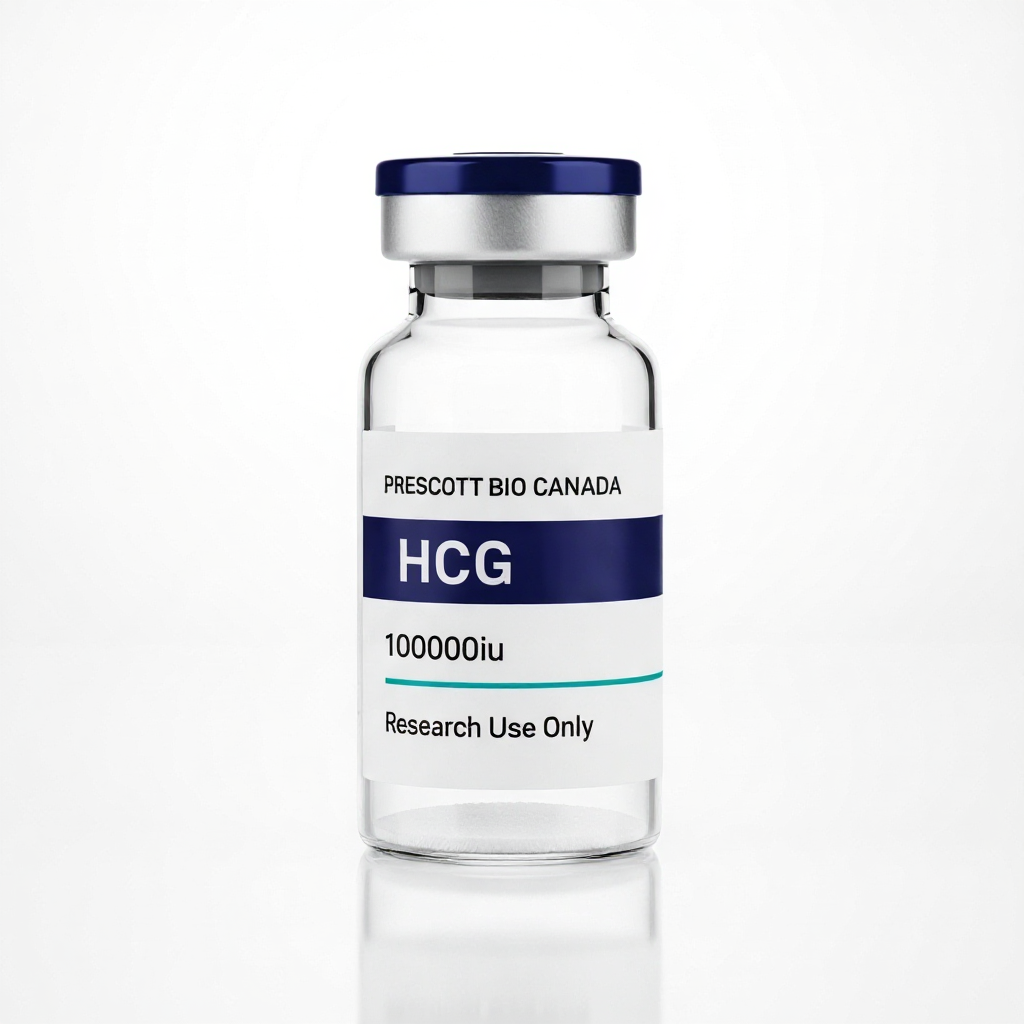
Description
Chemical Identity
Chorionic Gonadotropin analytical reference compound. Molecular weight 36700 Da. Research status: Approved.
Research Overview
Chorionic Gonadotropin (Human Chorionic Gonadotropin) is a glycoprotein hormone composed of alpha and beta subunits. It mimics luteinizing hormone (LH) activity and is FDA-approved for treatment of hypogonadism, cryptorchidism, and as part of assisted reproductive technology protocols.
Human chorionic gonadotropin (hCG) is a heterodimeric glycoprotein hormone that binds and activates the luteinizing hormone/chorionic gonadotropin receptor (LChorionic GonadotropinR), a class A GPCR expressed in gonadal and reproductive tissues. High-resolution structures show hCG engages the large extracellular domain (ECD) and activates the transmembrane core via a hinge “push–pull” mechanism in which a conserved hinge loop fragment (P10) functions as a tethered agonist, stabilizing an active 7TM conformation that couples to G proteins and β-arrestins (simoniUnknownyearoggettoendocrinereviewsproposal pages 19-20). Ligand-specific contacts at the ECD/hinge and hormone glycosylation underlie biased signaling differences between hCG and LH (casariniUnknownyearadvancearticle pages 17-18).
Canonical Gs–cAMP–PKA signaling and steroidogenesis • LChorionic GonadotropinR–Gs activates adenylyl cyclase, elevating cAMP and activating PKA. PKA phosphorylates CREB and promotes transcription of steroidogenic genes, notably STARD1 (StAR) and CYP enzymes including CYP11A1, coordinating cholesterol transfer to mitochondria and conversion to pregnenolone; StAR phosphorylation and expression are integral to the acute steroidogenic response. In human granulosa-lutein cells, hCG is about fivefold more potent than LH for cAMP generation and produces slower, sustained cAMP kinetics; this bias correlates with stronger CRE-driven transcription and sustained steroidogenic drive and progesterone output under equipotent stimulation.
Objective: To summarize therapeutic applications and documented outcomes of hCG across preclinical and clinical research, highlighting designs, doses, comparators, endpoints, efficacy and safety.
Key published studies on Chorionic Gonadotropin include: “Gonadotropins for pubertal induction in males with hypogonadotropic hypogonadism: systematic review and meta-analysis” (European Journal of Endocrinology, 2024); “GnRH agonist and hCG (dual trigger) versus hCG trigger for final follicular maturation: a double-blinded, randomized controlled study” (Human Reproduction, 2020); “Concomitant intramuscular human chorionic gonadotropin preserves spermatogenesis in men undergoing testosterone replacement therapy” (Journal of Urology, 2013). These findings should be interpreted within the context of the experimental models and conditions described in each publication.
Research Context
β-arrestin recruitment, receptor trafficking, and endosomal signaling • Agonist-occupied LChorionic GonadotropinR is phosphorylated by GRKs, recruits β-arrestins, and internalizes. β-arrestins scaffold MAPK components to generate a delayed ERK1/2 wave and associate with PDEs to modulate cAMP microdomains. Internalized LChorionic GonadotropinR can remain signaling-competent in endosomes, forming complexes with G proteins and β-arrestins that sustain cAMP (regulated by APPL1) (simoniUnknownyearoggettoendocrinereviewsproposal pages 20-22). Compared with LH, hCG more effectively promotes β-arrestin-2 recruitment, receptor aggregation/internalization, and sustained cAMP, supporting ligand-biased outcomes (casariniUnknownyearadvancearticle pages 20-21, simoniUnknownyearoggettoendocrinereviewsproposal pages 20-22).
ERK/MAPK and PI3K/AKT pathways • LChorionic GonadotropinR activation also engages ERK/MAPK and PI3K/AKT. ERK and AKT contribute to survival, differentiation, and are required, together with PKA, for full STARD1 expression in several contexts (simoniUnknownyearoggettoendocrinereviewsproposal pages 20-22). In primary human granulosa cells, LH elicits stronger and more sustained ERK1/2 and AKT phosphorylation than hCG at equipotent doses, consistent with a proliferative/survival bias of LH versus a steroidogenic bias of hCG.
PLC–IP3/DAG–Ca2+ signaling • LChorionic GonadotropinR couples to Gq/11, activating PLC to produce IP3 and DAG, mobilizing Ca2+ and activating PKC. Ca2+/calmodulin-dependent kinases facilitate cholesterol transport and acute steroidogenesis, and PKC can feed into ERK signaling. In some systems hCG preferentially engages Gq/Ca2+ over LH, though Ca2+ mobilization generally requires higher agonist concentrations than cAMP (simoniUnknownyearoggettoendocrinereviewsproposal pages 20-22).
Specifications
| Sequence | Heterodimer: alpha subunit (92 aa) + beta subunit (145 aa), 237 aa total |
| Molecular Weight | 36700 Da |
| Molecular Formula | Glycoprotein heterodimer (~25.7 kDa peptide + ~10-15 kDa glycans) |
| CAS Number | 9002-61-3 |
| Purity | >=98% (HPLC) |
| Appearance | White to off-white lyophilized powder |
| Format | Lyophilized powder, sterile filtered |
| Solubility | Soluble in bacteriostatic water, sterile water, or normal saline |
| Storage | Store at -20°C (lyophilized). Reconstituted: 2-8°C, use within 30 days |
| Shipping | Ambient temperature (stable in lyophilized form) |
Each lot is accompanied by a Certificate of Analysis (COA) documenting purity, identity, and endotoxin testing results.
Research Applications
Chorionic Gonadotropin reference compound has been documented in the published scientific literature across the following in vitro and preclinical research areas:
- Male hypogonadism treatment
- Ovulation induction in fertility treatments
- Cryptorchidism treatment in pediatric patients
- Testosterone restoration adjunct therapy
Researchers are advised to consult the primary literature for detailed experimental protocols, concentrations, and conditions relevant to their specific area of investigation involving Chorionic Gonadotropin.
Storage and Handling
Chorionic Gonadotropin is supplied as a lyophilized powder and should be stored at -20°C upon receipt for long-term stability. Protect from light, moisture, and repeated temperature fluctuations. Allow the sealed vial to equilibrate to room temperature before opening to prevent condensation and moisture absorption.
For reconstitution, add sterile water or an appropriate buffer slowly along the vial wall to avoid foaming. Gently swirl to dissolve — do not vortex. Reconstituted Chorionic Gonadotropin solutions should be stored at 2-8°C and used within 30 days. Aliquoting is recommended to minimize freeze-thaw cycles. Consult the Safety Data Sheet (SDS) for detailed handling and disposal guidance.
For laboratory research use only (in vitro). Not for human or animal use. Not for diagnostic, therapeutic, or clinical purposes. Chorionic Gonadotropin is supplied as an analytical reference compound for use by qualified research personnel at accredited institutions. Prescott Bio Canada does not provide guidance on administration, dosing, or use in living organisms.