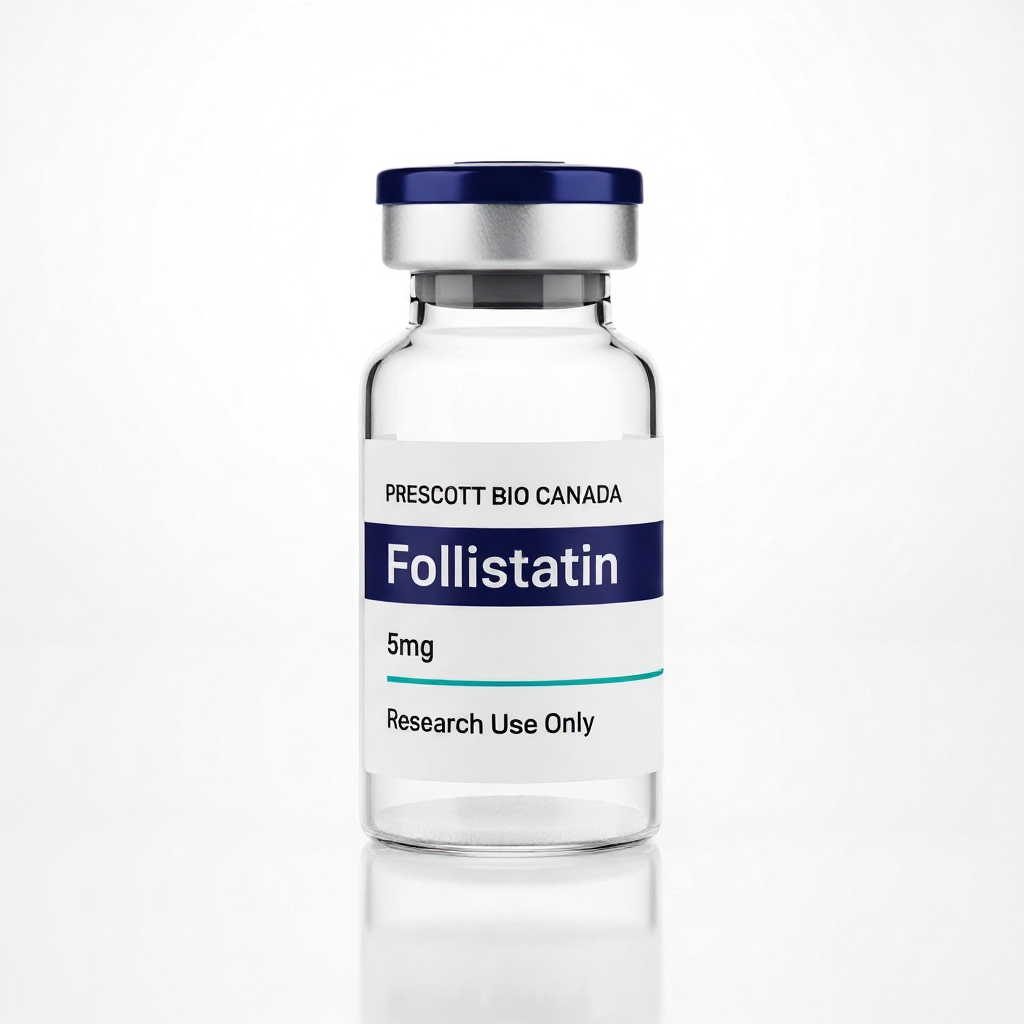
Description
Chemical Identity
Follistatin analytical reference compound. Molecular weight 38000 Da. Also known as: FST, Activin-Binding Protein, FST-344. Research status: Phase2.
Research Overview
Follistatin is a naturally occurring glycoprotein that binds and neutralizes members of the TGF-beta superfamily, particularly activin and myostatin (GDF-8). By inhibiting myostatin, follistatin promotes skeletal muscle growth and has been investigated in gene therapy clinical trials for Becker muscular dystrophy and inclusion body myositis with encouraging preliminary results.
Follistatin’s most therapeutically relevant function is its ability to bind and neutralize myostatin, the primary negative regulator of skeletal muscle mass. Myostatin normally signals through activin receptor type IIB (ActRIIB) to activate Smad2/3 signaling, which suppresses muscle protein synthesis and promotes muscle atrophy. By sequestering myostatin, follistatin removes this brake on muscle growth, allowing enhanced muscle hypertrophy.
The structural basis for this interaction has been elucidated through crystallography. Follistatin wraps around the myostatin dimer, occluding the receptor-binding interface and preventing myostatin from engaging its receptor. This inhibition is essentially irreversible under physiological conditions, as the follistatin-myostatin complex is cleared from circulation.
The most advanced clinical application of follistatin is in gene therapy for muscular dystrophy. Mendell and colleagues conducted a Phase 1/2a clinical trial using AAV1-delivered follistatin (AAV1.CMV.huFS344) for Becker muscular dystrophy. Intramuscular injection into the quadriceps muscles showed improved ambulatory function, with the high-dose cohort showing increased 6-minute walk test distance by up to 108 meters. Histological analysis demonstrated reduced endomysial fibrosis and muscle fiber hypertrophy.
Key published studies on Follistatin include: “Follistatin Gene Therapy for Sporadic Inclusion Body Myositis Improves Functional Outcomes” (Molecular Therapy, 2017); “A Phase 1/2a Follistatin Gene Therapy Trial for Becker Muscular Dystrophy” (Molecular Therapy, 2015); “Inhibition of myostatin with emphasis on follistatin as a therapy for muscle disease” (Muscle and Nerve, 2009). These findings should be interpreted within the context of the experimental models and conditions described in each publication.
Research Context
Follistatin is a naturally occurring glycoprotein synthesized in nearly all tissues of higher animals. It was originally identified as an activin-binding protein that suppresses follicle-stimulating hormone (FSH) secretion from the anterior pituitary, hence its name. Follistatin functions primarily by binding and neutralizing members of the TGF-beta superfamily, with particular affinity for activin A, activin B, and myostatin (GDF-8).
Three major isoforms of follistatin are produced through alternative splicing of the FST gene: FST-288, FST-303, and FST-315. FST-315 is the predominant circulating form, accounting for approximately 95% of all follistatin in the blood. FST-288 has the highest affinity for heparan sulfate proteoglycans and tends to remain bound to cell surfaces. The FST-344 precursor (containing a 29-residue C-terminal extension that is cleaved to generate FST-315) has been used in gene therapy research due to its favorable biological properties.
Follistatin also binds activin A and B with high affinity. Activins play roles in reproductive biology, inflammation, fibrosis, and metabolism. Follistatin-mediated activin neutralization affects FSH secretion, hepatic function, and inflammatory responses, contributing to the pleiotropic effects observed with follistatin overexpression.
Specifications
| Sequence | 344 amino acid glycoprotein (FST-344 isoform) |
| Molecular Weight | 38000 Da |
| Molecular Formula | Glycoprotein (multiple isoforms) |
| CAS Number | 136470-78-5 |
| Purity | >=98% (HPLC) |
| Appearance | White to off-white lyophilized powder |
| Format | Lyophilized powder, sterile filtered |
| Solubility | Soluble in bacteriostatic water, sterile water, or normal saline |
| Storage | Store at -20°C (lyophilized). Reconstituted: 2-8°C, use within 30 days |
| Shipping | Ambient temperature (stable in lyophilized form) |
Each lot is accompanied by a Certificate of Analysis (COA) documenting purity, identity, and endotoxin testing results.
Research Applications
Follistatin reference compound has been documented in the published scientific literature across the following in vitro and preclinical research areas:
- Myostatin Inhibition
- Activin Neutralization
- Gene Therapy for Muscular Dystrophy
- Muscle Wasting and Sarcopenia
Researchers are advised to consult the primary literature for detailed experimental protocols, concentrations, and conditions relevant to their specific area of investigation involving Follistatin.
Storage and Handling
Follistatin is supplied as a lyophilized powder and should be stored at -20°C upon receipt for long-term stability. Protect from light, moisture, and repeated temperature fluctuations. Allow the sealed vial to equilibrate to room temperature before opening to prevent condensation and moisture absorption.
For reconstitution, add sterile water or an appropriate buffer slowly along the vial wall to avoid foaming. Gently swirl to dissolve — do not vortex. Reconstituted Follistatin solutions should be stored at 2-8°C and used within 30 days. Aliquoting is recommended to minimize freeze-thaw cycles. Consult the Safety Data Sheet (SDS) for detailed handling and disposal guidance.
For laboratory research use only (in vitro). Not for human or animal use. Not for diagnostic, therapeutic, or clinical purposes. Follistatin is supplied as an analytical reference compound for use by qualified research personnel at accredited institutions. Prescott Bio Canada does not provide guidance on administration, dosing, or use in living organisms.