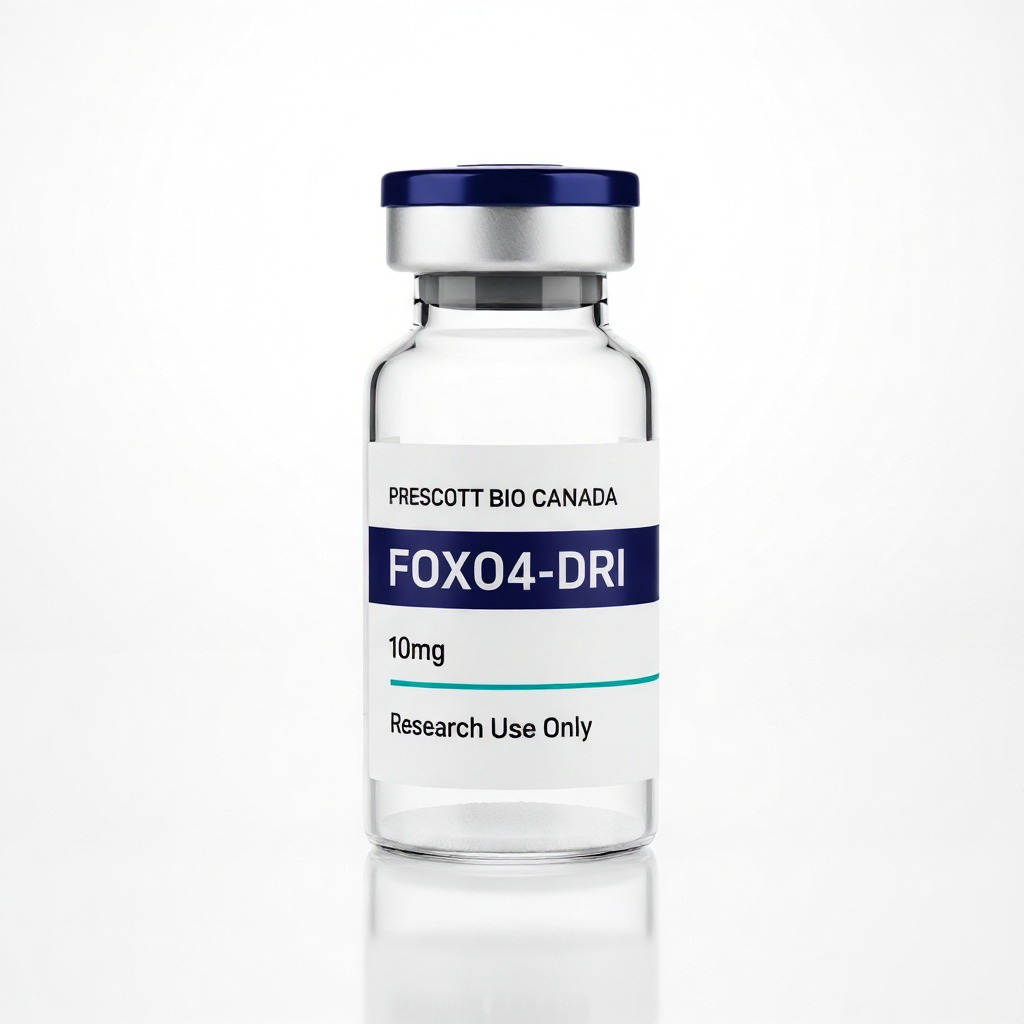
Description
Chemical Identity
FOXO4-DRI analytical reference compound. Molecular weight 4826.5 Da. Also known as: FOXO4-D-Retro-Inverso, Proxofim, FOXO4 DRI. Research status: Preclinical.
Research Overview
FOXO4-DRI is a D-Retro-Inverso (DRI) peptide designed to selectively induce apoptosis in senescent cells by disrupting the interaction between FOXO4 and p53 transcription factors. By using D-amino acids in a reversed sequence, FOXO4-DRI resists protease degradation while mimicking the FOXO4-p53 binding interface. It was developed by Baar et al. (2017) at Erasmus University Medical Center.
The mechanism of FOXO4-DRI centers on a specific protein-protein interaction between the Forkhead box O4 (FOXO4) transcription factor and the tumor suppressor protein p53. In senescent cells, p53 plays a dual role: it helps initiate and maintain the senescent state, but it also retains the capacity to trigger apoptosis. The fate decision between senescence (survival with growth arrest) and apoptosis (cell death) depends on the intracellular localization and binding partners of p53.
In senescent cells, FOXO4 expression is upregulated and FOXO4 becomes enriched in promyelocytic leukemia (PML) nuclear bodies, where it forms a complex with p53. This FOXO4-p53 interaction sequesters p53 within PML bodies and shifts the p53 transcriptional program away from pro-apoptotic targets (such as BAX, PUMA, and NOXA) and toward cell cycle arrest targets (such as p21/CDKN1A). The net effect is that senescent cells survive despite harboring activated p53, because FOXO4 diverts p53 from its apoptotic program.
The foundational preclinical evidence for FOXO4-DRI comes from the 2017 publication by Baar, Brandt, Putavet et al. in Cell. This study reported several key findings that established the proof of concept for FOXO4-DRI as a senolytic agent.
Key published studies on FOXO4-DRI include: “Targeted Apoptosis of Senescent Cells Restores Tissue Homeostasis in Response to Chemotoxicity and Aging” (Cell, 2017). These findings should be interpreted within the context of the experimental models and conditions described in each publication.
Research Context
FOXO4-DRI is a synthetic peptide designed to selectively eliminate senescent cells — aged, damaged cells that have permanently exited the cell cycle but resist normal programmed cell death. The peptide was developed by a research team led by Peter de Keizer at the Erasmus University Medical Center in Rotterdam, Netherlands, with the seminal findings published in the journal Cell in 2017 by Baar et al. The name FOXO4-DRI reflects both its molecular target (the FOXO4 transcription factor) and its structural design (D-Retro-Inverso modification).
The peptide has a molecular weight of approximately 4826.5 Da and is constructed using the D-Retro-Inverso (DRI) approach, in which the original L-amino acid sequence of the FOXO4-p53 binding interface is reversed in order and synthesized using D-amino acids rather than the naturally occurring L-forms. This DRI modification preserves the spatial orientation of amino acid side chains, allowing the peptide to mimic the binding surface of the native protein while conferring substantial resistance to degradation by cellular proteases that have evolved to cleave L-amino acid peptide bonds.
FOXO4-DRI belongs to the emerging class of senolytic agents — compounds that selectively kill senescent cells. Cellular senescence is a state of irreversible growth arrest accompanied by a pro-inflammatory secretory phenotype (the senescence-associated secretory phenotype, or SASP). The accumulation of senescent cells in tissues during aging and in response to various stressors is increasingly recognized as a key driver of age-related pathology, chronic inflammation, and functional decline. By selectively targeting these cells for elimination, senolytic agents aim to restore tissue function and potentially reverse aspects of aging.
Specifications
| Sequence | D-Retro-Inverso modified (all D-amino acids, reversed sequence) |
| Molecular Weight | 4826.5 Da |
| Molecular Formula | C228H388N86O64 |
| Purity | >=98% (HPLC) |
| Appearance | White to off-white lyophilized powder |
| Format | Lyophilized powder, sterile filtered |
| Solubility | Soluble in bacteriostatic water, sterile water, or normal saline |
| Storage | Store at -20°C (lyophilized). Reconstituted: 2-8°C, use within 30 days |
| Shipping | Ambient temperature (stable in lyophilized form) |
Each lot is accompanied by a Certificate of Analysis (COA) documenting purity, identity, and endotoxin testing results.
Research Applications
FOXO4-DRI reference compound has been documented in the published scientific literature across the following in vitro and preclinical research areas:
- The FOXO4-p53 Interaction in Senescent Cells
- Competitive Disruption by FOXO4-DRI
- D-Retro-Inverso Design Rationale
- Baar et al. 2017 Cell Paper Findings
- Senescent Cell Biology and the SASP
- Comparison with Small-Molecule Senolytics
- Single Research Group and Limited Replication
- No Human Clinical Data
Researchers are advised to consult the primary literature for detailed experimental protocols, concentrations, and conditions relevant to their specific area of investigation involving FOXO4-DRI.
Storage and Handling
FOXO4-DRI is supplied as a lyophilized powder and should be stored at -20°C upon receipt for long-term stability. Protect from light, moisture, and repeated temperature fluctuations. Allow the sealed vial to equilibrate to room temperature before opening to prevent condensation and moisture absorption.
For reconstitution, add sterile water or an appropriate buffer slowly along the vial wall to avoid foaming. Gently swirl to dissolve — do not vortex. Reconstituted FOXO4-DRI solutions should be stored at 2-8°C and used within 30 days. Aliquoting is recommended to minimize freeze-thaw cycles. Consult the Safety Data Sheet (SDS) for detailed handling and disposal guidance.
For laboratory research use only (in vitro). Not for human or animal use. Not for diagnostic, therapeutic, or clinical purposes. FOXO4-DRI is supplied as an analytical reference compound for use by qualified research personnel at accredited institutions. Prescott Bio Canada does not provide guidance on administration, dosing, or use in living organisms.