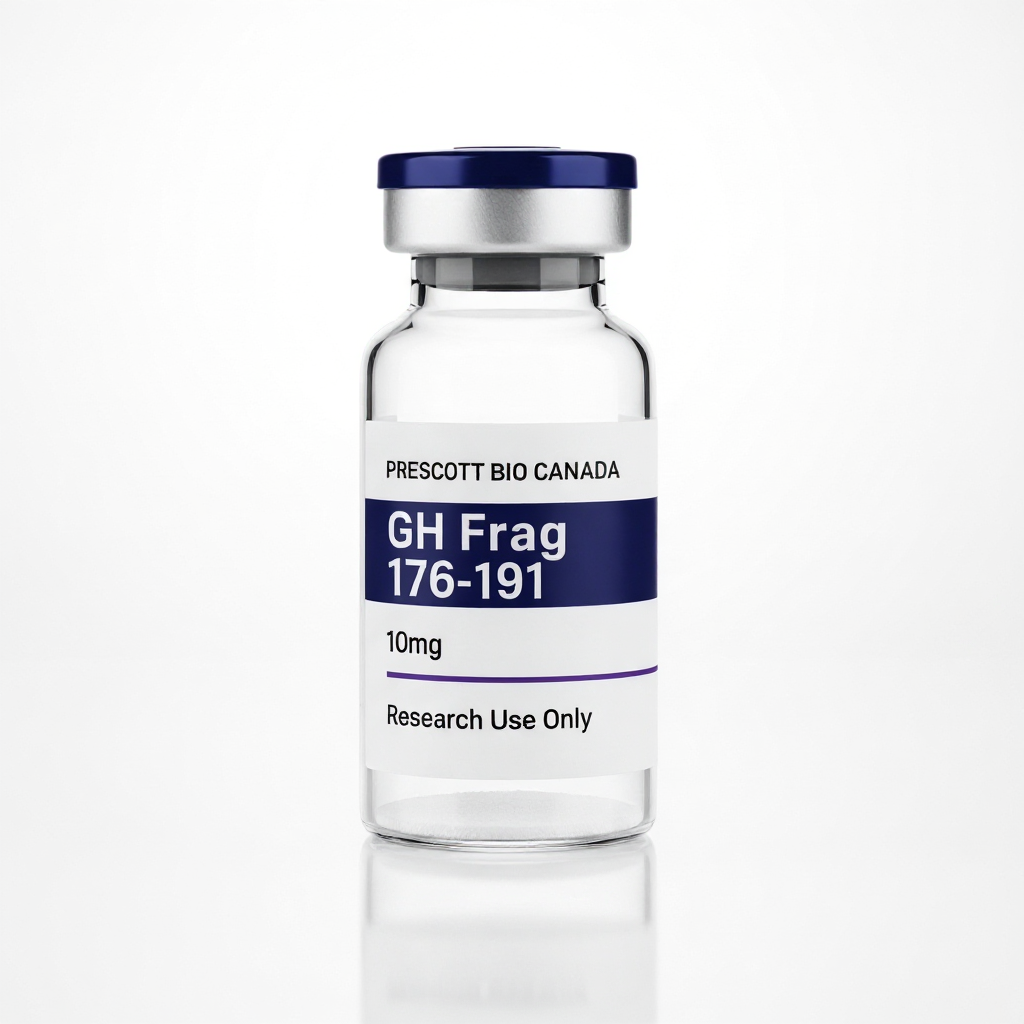
Description
Chemical Identity
GH Fragment 176-191 is a synthetic peptide corresponding to amino acids 176-191 of human growth hormone with the molecular formula C78H125N23O23S2 and a molecular weight of 1817.12 Da (CAS number 221231-10-3). The amino acid sequence is YLRIVQCRSVEGSCGF, featuring an intramolecular disulfide bond between Cys7 and Cys14. This fragment represents the C-terminal “mini-loop” region of human growth hormone identified as the lipolytic domain.
Unlike the closely related AOD-9604 peptide, which incorporates a tyrosine-for-phenylalanine substitution at the N-terminus, GH Fragment 176-191 retains the native sequence with tyrosine at the equivalent position. Both peptides target the same lipolytic mechanism while lacking growth hormone receptor binding activity.
| Property | Value |
|---|---|
| Molecular Formula | C78H125N23O23S2 |
| Molecular Weight | 1817.12 Da |
| CAS Number | 221231-10-3 |
| Sequence | YLRIVQCRSVEGSCGF |
| Research Status | Preclinical |
Research Overview
GH Fragment 176-191 has been investigated in preclinical research focused on lipolysis and fat metabolism. The primary mechanism involves stimulation of fat oxidation through beta-3 adrenergic receptor-dependent pathways, analogous to the full-length hGH C-terminal domain’s lipolytic activity but without engaging the growth hormone receptor responsible for IGF-1 elevation, hyperglycemia, and growth-promoting effects.
The critical disulfide bond between Cys7 and Cys14 maintains the cyclic loop structure that mirrors the Cys182-Cys189 bond in native hGH, and this structural motif is essential for biological activity.
Key areas of published research include:
- Lipolytic Activity: Preclinical studies demonstrate that GH Fragment 176-191 stimulates lipolysis and inhibits lipogenesis in adipose tissue without affecting glucose homeostasis, IGF-1 levels, or cellular proliferation, establishing a clean separation between lipolytic and somatotropic activities of growth hormone.
- Metabolic Selectivity: The fragment does not compete for the GH receptor and does not induce the diabetogenic, growth-promoting, or cell-proliferative effects of full-length growth hormone, making it a selective tool for studying the lipolytic domain of hGH.
- Structure-Activity Relationships: Comparative studies with AOD-9604 and other hGH C-terminal fragments have elucidated the structural requirements for lipolytic activity, including the importance of the disulfide bond and specific residues within the cyclic loop region.
GH Fragment 176-191 remains a preclinical research compound with no regulatory approvals.
Specifications
All GH Fragment 176-191 supplied by Prescott Bio Canada is manufactured to research-grade standards.
| Specification | Detail |
|---|---|
| Purity | >98% (HPLC) |
| Form | Lyophilized powder |
| Appearance | White to off-white powder |
| Storage (lyophilized) | -20°C, protected from light |
| Storage (reconstituted) | 2-8°C, use within 30 days |
| Solubility | Soluble in bacteriostatic water, sterile water, or normal saline |
Each vial is accompanied by a Certificate of Analysis (COA) documenting purity, identity, and endotoxin testing.
Research Applications
GH Fragment 176-191 is supplied exclusively for in vitro and in vivo laboratory research. Published experimental applications include:
- Fat metabolism and lipolytic mechanism research in adipocyte models
- Growth hormone structure-activity relationship studies
- Beta-3 adrenergic receptor signaling pathway research
- Comparative studies with full-length hGH and AOD-9604
- Metabolic selectivity research examining lipolytic versus somatotropic activity
Researchers should consult the primary literature and institutional review protocols before designing experiments with GH Fragment 176-191.
Storage and Handling
Lyophilized powder: Store at -20°C in the original sealed vial, protected from light and moisture. Under these conditions, GH Fragment 176-191 maintains stability for up to 24 months. Avoid reducing agents that could disrupt the disulfide bond essential for biological activity.
Reconstituted solution: Reconstitute with bacteriostatic water or sterile water to the desired concentration. Store reconstituted GH Fragment 176-191 at 2-8°C and use within 30 days. Avoid repeated freeze-thaw cycles.
Handling precautions: This product is intended for research use only (RUO). Not for human or veterinary diagnostic or therapeutic use. Handle using standard laboratory safety practices including appropriate PPE.