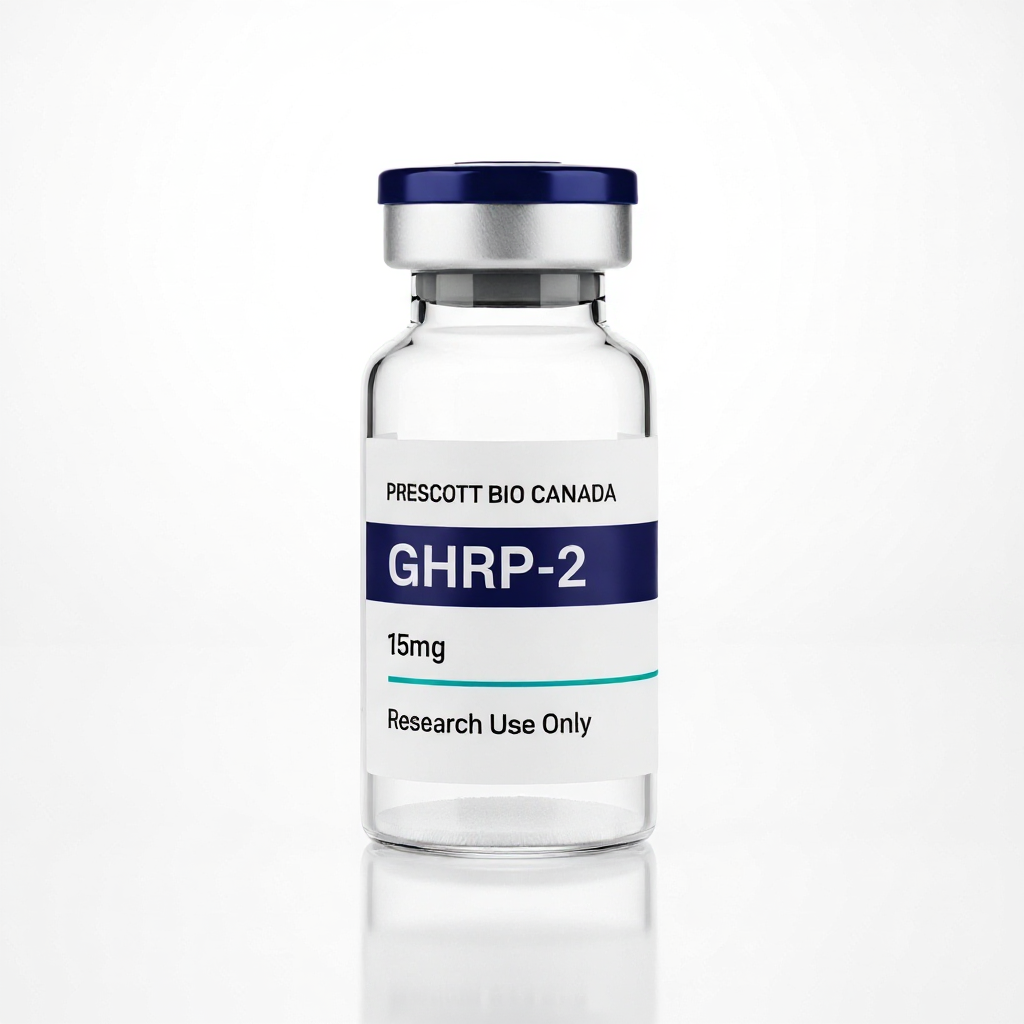
Description
Chemical Identity
GHRP-2 (Growth Hormone Releasing Peptide-2), also known as Pralmorelin or KP-102, is a synthetic hexapeptide growth hormone secretagogue with the molecular formula C45H55N9O6 and a molecular weight of 817.9 Da (CAS number 158861-67-7). The amino acid sequence is D-Ala-D-2-Nal-Ala-Trp-D-Phe-Lys-NH2, incorporating unnatural amino acids (D-configuration residues and beta-naphthylalanine) that confer metabolic stability and receptor selectivity.
GHRP-2 holds the distinction of being the only GHRP-class peptide with regulatory approval in any country, marketed as GHRP Kaken by Kaken Pharmaceutical in Japan for use as a diagnostic agent for growth hormone deficiency assessment.
| Property | Value |
|---|---|
| Molecular Formula | C45H55N9O6 |
| Molecular Weight | 817.9 Da |
| CAS Number | 158861-67-7 |
| Sequence | D-Ala-D-2-Nal-Ala-Trp-D-Phe-Lys-NH2 |
| Research Status | Approved (diagnostic use, Japan) |
Research Overview
GHRP-2 has been investigated in clinical and preclinical research spanning GH secretion dynamics, neuroendocrine function testing, and growth hormone axis pharmacology. The primary mechanism involves activation of the GHS-R1a receptor (ghrelin receptor), a G protein-coupled receptor on anterior pituitary somatotrophs. Upon binding, GHRP-2 triggers Gq/11-coupled phospholipase C activation, generating IP3 and DAG, which drive intracellular calcium elevation and exocytosis of GH-containing secretory vesicles.
GHRP-2 demonstrates favorable selectivity among GH secretagogues, producing robust GH release with relatively modest stimulation of cortisol and prolactin compared to other GHRP-class compounds. Unlike the endogenous ligand ghrelin, GHRP-2 does not require acylation for receptor binding.
Key areas of published research include:
- GH Deficiency Diagnosis: The approved clinical application involves intravenous administration of 100 micrograms of GHRP-2 as a provocative test for GH deficiency. Serial blood sampling over 60-120 minutes assesses pituitary GH secretory capacity. The test can distinguish between hypothalamic and pituitary causes of GH deficiency.
- GH Secretion Pharmacology: Studies have characterized the dose-response relationship and selectivity profile of GHRP-2, demonstrating that it produces significant GH elevation while maintaining favorable cortisol and prolactin ratios compared to GHRP-6 and other secretagogues.
- Ghrelin Receptor Biology: GHRP-2 binds to a site on GHS-R1a distinct from the ghrelin binding pocket, potentially stabilizing different receptor conformations. This makes it a valuable pharmacological tool for studying ghrelin receptor signaling.
GHRP-2 is approved in Japan as a diagnostic agent. It is not approved for therapeutic use in any jurisdiction.
Specifications
All GHRP-2 supplied by Prescott Bio Canada is manufactured to research-grade standards.
| Specification | Detail |
|---|---|
| Purity | >98% (HPLC) |
| Form | Lyophilized powder |
| Appearance | White to off-white powder |
| Storage (lyophilized) | -20°C, protected from light |
| Storage (reconstituted) | 2-8°C, use within 30 days |
| Solubility | Soluble in bacteriostatic water, sterile water, or normal saline |
Each vial is accompanied by a Certificate of Analysis (COA) documenting purity, identity, and endotoxin testing.
Research Applications
GHRP-2 is supplied exclusively for in vitro and in vivo laboratory research. Published experimental applications include:
- Growth hormone secretion dynamics and pituitary function research
- Ghrelin receptor (GHS-R1a) binding and signaling pathway studies
- GH deficiency diagnostic test development and validation
- Neuroendocrine axis research including cortisol and prolactin co-regulation
- Comparative secretagogue pharmacology studies
- Combination studies with GHRH analogs examining synergistic GH release
Researchers should consult the primary literature and institutional review protocols before designing experiments with GHRP-2.
Storage and Handling
Lyophilized powder: Store at -20°C in the original sealed vial, protected from light and moisture. Under these conditions, GHRP-2 maintains stability for up to 24 months.
Reconstituted solution: Reconstitute with bacteriostatic water or sterile water to the desired concentration. Store reconstituted GHRP-2 at 2-8°C and use within 30 days. Avoid repeated freeze-thaw cycles.
Handling precautions: This product is intended for research use only (RUO). Not for human or veterinary diagnostic or therapeutic use. Handle using standard laboratory safety practices including appropriate PPE.