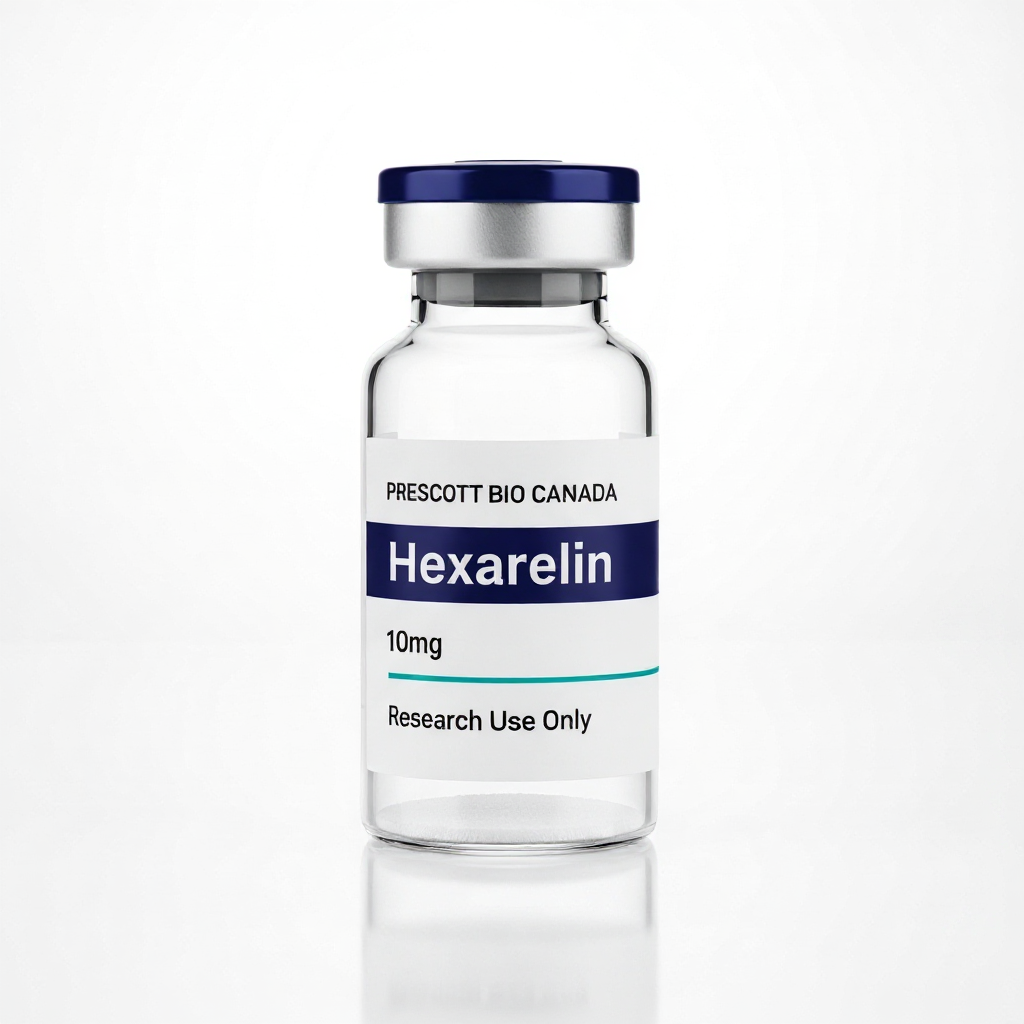
Description
Chemical Identity
Hexarelin (also known as Examorelin or HEX) is a synthetic hexapeptide growth hormone secretagogue with the molecular formula C47H58N12O6 and a molecular weight of 887 Da (CAS number 140703-51-1). The amino acid sequence is His-D-2-methyl-Trp-Ala-Trp-D-Phe-Lys-NH2, incorporating a methylated tryptophan residue that contributes to its potency among the GHRP class of compounds.
Hexarelin is distinguished from other growth hormone secretagogues by its dual receptor binding profile: it activates both the GHS-R1a (ghrelin) receptor for GH release and the CD36 scavenger receptor, conferring GH-independent cardioprotective effects that have been a significant focus of clinical investigation.
| Property | Value |
|---|---|
| Molecular Formula | C47H58N12O6 |
| Molecular Weight | 887 Da |
| CAS Number | 140703-51-1 |
| Sequence | His-D-2-methyl-Trp-Ala-Trp-D-Phe-Lys-NH2 |
| Research Status | Phase 2 clinical trials |
Research Overview
Hexarelin has been investigated in Phase 2 clinical trials and extensive preclinical research spanning growth hormone secretion, cardioprotection, and ischemia-reperfusion injury. The GH-releasing mechanism involves activation of GHS-R1a on anterior pituitary somatotrophs, triggering Gq/11-coupled phospholipase C signaling and calcium-dependent GH exocytosis. Hexarelin is considered among the most potent synthetic GH secretagogues characterized to date.
The unique CD36 receptor binding distinguishes Hexarelin pharmacologically. CD36 is a scavenger receptor expressed on cardiomyocytes, macrophages, and endothelial cells, and Hexarelin’s interaction with this receptor mediates cardioprotective effects independent of GH release.
Key areas of published research include:
- Growth Hormone Release: Hexarelin produces robust, dose-dependent GH release in clinical studies. It is among the most potent GHRP-class compounds, though it also stimulates cortisol and prolactin to a greater degree than more selective secretagogues like ipamorelin.
- Cardioprotection: Phase 2 clinical trials have evaluated Hexarelin for cardioprotective effects. Preclinical ischemia-reperfusion models have demonstrated significant reduction in myocardial damage, mediated through CD36 receptor activation independent of GH signaling.
- CD36 Receptor Biology: Hexarelin’s binding to CD36 has made it a valuable research tool for studying scavenger receptor pharmacology, atherosclerosis, and cardiac repair mechanisms.
Hexarelin has advanced to Phase 2 clinical trials but has not received regulatory approval for any indication.
Specifications
All Hexarelin supplied by Prescott Bio Canada is manufactured to research-grade standards.
| Specification | Detail |
|---|---|
| Purity | >98% (HPLC) |
| Form | Lyophilized powder |
| Appearance | White to off-white powder |
| Storage (lyophilized) | -20°C, protected from light |
| Storage (reconstituted) | 2-8°C, use within 30 days |
| Solubility | Soluble in bacteriostatic water, sterile water, or normal saline |
Each vial is accompanied by a Certificate of Analysis (COA) documenting purity, identity, and endotoxin testing.
Research Applications
Hexarelin is supplied exclusively for in vitro and in vivo laboratory research. Published experimental applications include:
- Growth hormone secretagogue receptor pharmacology and potency comparison studies
- Cardioprotective mechanism research including ischemia-reperfusion models
- CD36 scavenger receptor signaling and binding studies
- Comparative GH secretagogue studies examining selectivity profiles
- Atherosclerosis and vascular biology research
Researchers should consult the primary literature and institutional review protocols before designing experiments with Hexarelin.
Storage and Handling
Lyophilized powder: Store at -20°C in the original sealed vial, protected from light and moisture. Under these conditions, Hexarelin maintains stability for up to 24 months.
Reconstituted solution: Reconstitute with bacteriostatic water or sterile water to the desired concentration. Store reconstituted Hexarelin at 2-8°C and use within 30 days. Avoid repeated freeze-thaw cycles.
Handling precautions: This product is intended for research use only (RUO). Not for human or veterinary diagnostic or therapeutic use. Handle using standard laboratory safety practices including appropriate PPE.