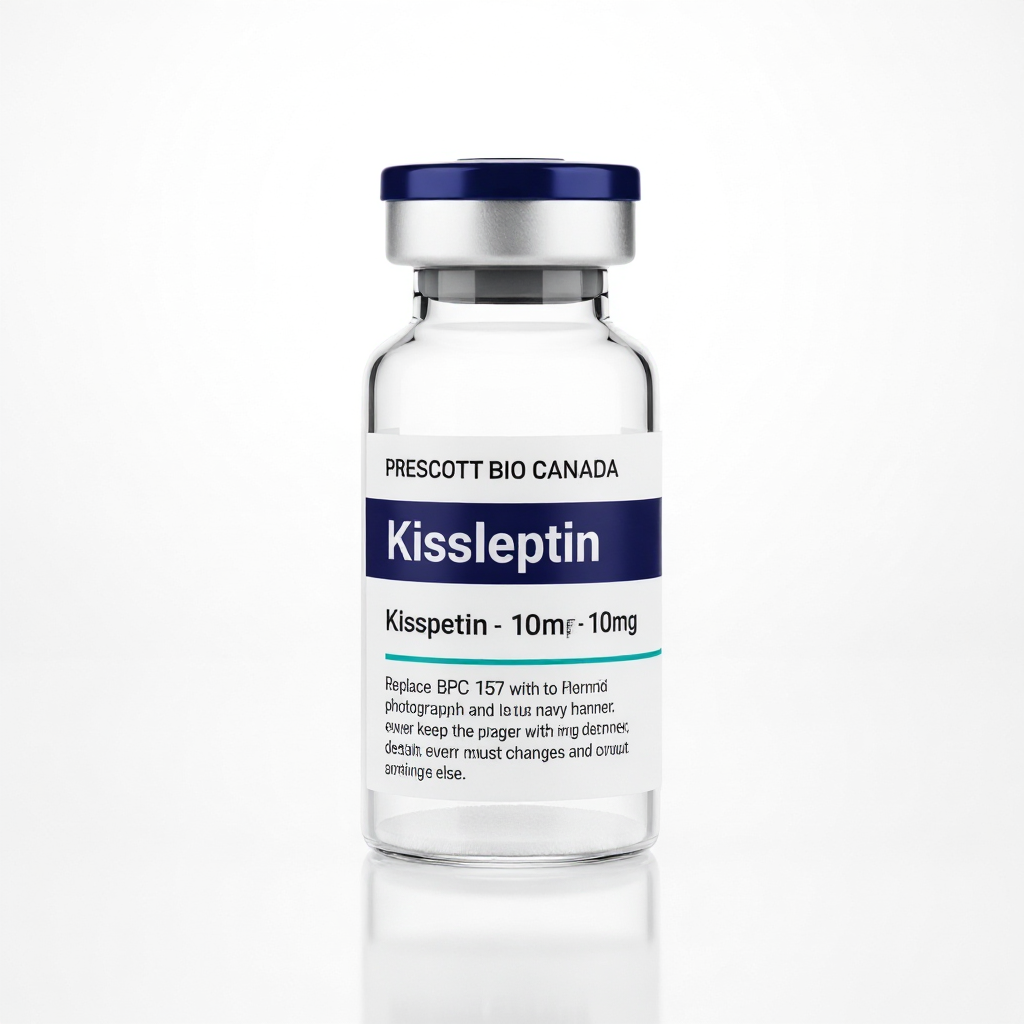
Description
Chemical Identity
Kisspeptin is a family of neuropeptides encoded by the KISS1 gene, with kisspeptin-10 (the C-terminal decapeptide) being the minimal active fragment with the molecular formula C257H383N69O74S3 and an approximate molecular weight of 5861.5 Da for the full-length kisspeptin-54 (CAS number 374675-21-5). Kisspeptin functions as a master regulator of the hypothalamic-pituitary-gonadal (HPG) axis, playing critical roles in puberty onset, reproductive function, and fertility.
All kisspeptin isoforms (kisspeptin-54, -14, -13, and -10) share a conserved C-terminal RF-amide motif required for receptor activation. Kisspeptin was originally identified as Metastin for its metastasis-suppressing properties and is also referred to as KiSS-1 peptide.
| Property | Value |
|---|---|
| Molecular Formula | C257H383N69O74S3 |
| Molecular Weight | ~5861.5 Da (kisspeptin-54) |
| CAS Number | 374675-21-5 |
| Sequence (Kisspeptin-10) | Tyr-Asn-Trp-Asn-Ser-Phe-Gly-Leu-Arg-Phe-NH2 |
| Research Status | Phase 2 clinical trials |
Research Overview
Kisspeptin has been investigated in Phase 2 clinical trials and extensive preclinical research in reproductive endocrinology. The primary mechanism involves binding to KISS1R (GPR54), a Gq/11-coupled GPCR expressed on GnRH neurons in the hypothalamus. Upon binding, kisspeptin activates phospholipase C-beta, generating IP3 and DAG, with the resulting intracellular calcium elevation depolarizing and activating GnRH neurons to trigger pulsatile GnRH release.
Kisspeptin is recognized as the most potent known endogenous stimulator of the reproductive hormone cascade, sitting at the apex of the HPG axis. Its discovery explained how metabolic status, circadian rhythms, and pubertal development are integrated with reproductive function.
Key areas of published research include:
- Reproductive Endocrinology: Clinical studies have demonstrated that kisspeptin administration potently stimulates LH and FSH release through GnRH neuron activation, with applications in fertility research including triggering oocyte maturation as an alternative to hCG in assisted reproduction protocols.
- Puberty and Development: Loss-of-function mutations in KISS1 or KISS1R cause hypogonadotropic hypogonadism and absent puberty in humans, establishing the kisspeptin system as essential for pubertal initiation and reproductive competence.
- Metastasis Suppression: Kisspeptin was originally identified through its metastasis-suppressing activity, and ongoing research examines KISS1/KISS1R signaling in cancer biology and tumor dissemination.
Kisspeptin-based therapeutics are in Phase 2 clinical development for reproductive medicine applications.
Specifications
All Kisspeptin supplied by Prescott Bio Canada is manufactured to research-grade standards.
| Specification | Detail |
|---|---|
| Purity | >98% (HPLC) |
| Form | Lyophilized powder |
| Appearance | White to off-white powder |
| Storage (lyophilized) | -20°C, protected from light |
| Storage (reconstituted) | 2-8°C, use within 30 days |
| Solubility | Soluble in bacteriostatic water, sterile water, or normal saline |
Each vial is accompanied by a Certificate of Analysis (COA) documenting purity, identity, and endotoxin testing.
Research Applications
Kisspeptin is supplied exclusively for in vitro and in vivo laboratory research. Published experimental applications include:
- Reproductive endocrinology and HPG axis regulation research
- GnRH neuron physiology and KISS1R signaling studies
- Fertility and assisted reproduction protocol development
- Puberty onset mechanisms and neuroendocrine development research
- Cancer metastasis suppression and KISS1 biology studies
- Metabolic-reproductive axis integration research
Researchers should consult the primary literature and institutional review protocols before designing experiments with Kisspeptin.
Storage and Handling
Lyophilized powder: Store at -20°C in the original sealed vial, protected from light and moisture. Under these conditions, Kisspeptin maintains stability for up to 24 months.
Reconstituted solution: Reconstitute with bacteriostatic water or sterile water to the desired concentration. Store reconstituted Kisspeptin at 2-8°C and use within 30 days. Avoid repeated freeze-thaw cycles.
Handling precautions: This product is intended for research use only (RUO). Not for human or veterinary diagnostic or therapeutic use. Handle using standard laboratory safety practices including appropriate PPE.