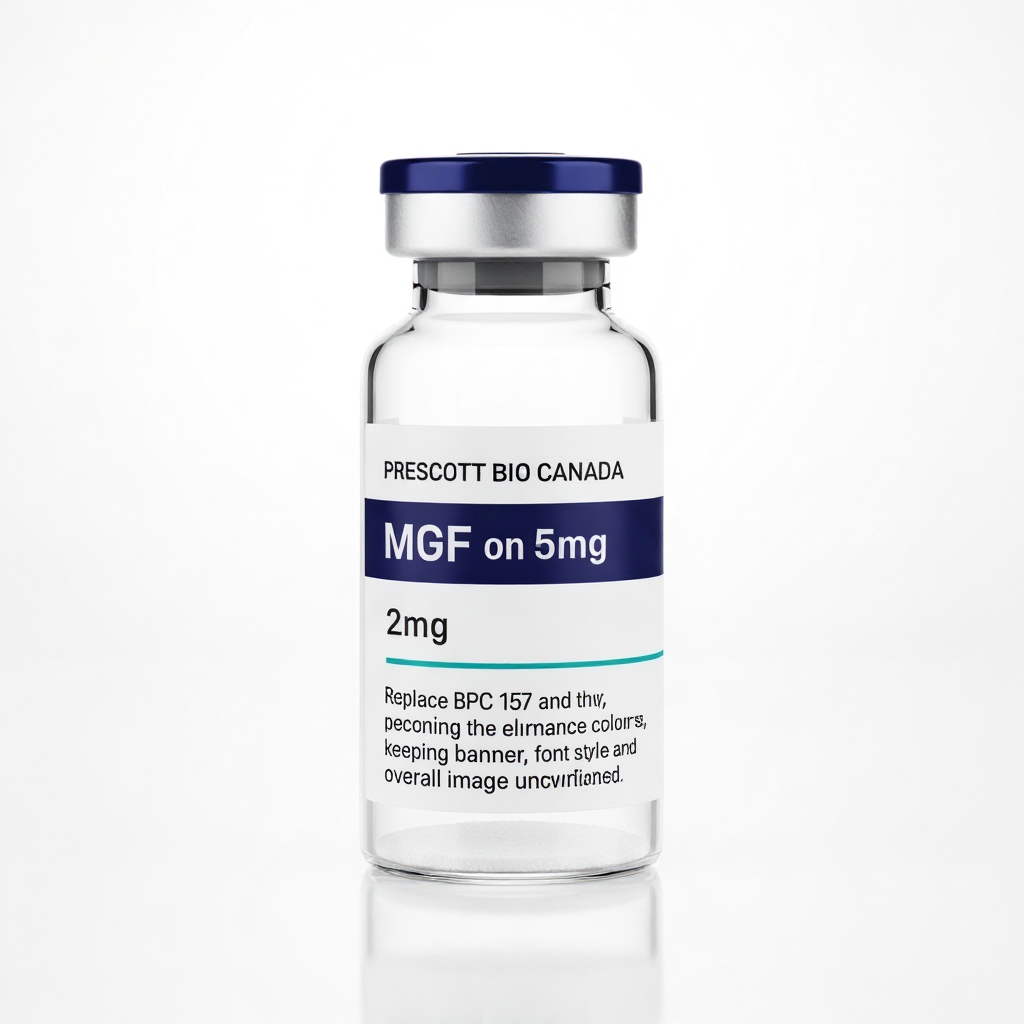
Description
Chemical Identity
MGF (Mechano Growth Factor) is a 24-amino acid peptide with the molecular formula C121H200N42O39 and a molecular weight of 2867.15 Da (CAS number 80214-83-1). The amino acid sequence is YQPPSTNKNTKSQRRKGSTFEEHK, corresponding to the unique C-terminal E-domain of the IGF-1Ec splice variant in humans. Unlike circulating IGF-1, MGF is expressed locally in skeletal muscle tissue in response to mechanical overload and damage.
MGF is also referred to as Mechano Growth Factor, IGF-1Ec, or MGF Peptide. The peptide was identified as a mechanosensitive splice variant of the IGF-1 gene that is rapidly upregulated following exercise or muscle injury, initiating local repair processes before systemic IGF-1 isoforms become predominant.
| Property | Value |
|---|---|
| Molecular Formula | C121H200N42O39 |
| Molecular Weight | 2867.15 Da |
| CAS Number | 80214-83-1 |
| Sequence | YQPPSTNKNTKSQRRKGSTFEEHK |
| Research Status | Preclinical |
Research Overview
MGF has been investigated in preclinical research spanning muscle repair, satellite cell biology, neurogenesis, and exercise physiology. The proposed mechanism involves activation of muscle satellite (stem) cells in response to mechanical loading, initiating proliferation before these cells differentiate and fuse with existing muscle fibers for repair. MGF signaling appears distinct from systemic IGF-1 isoforms, suggesting a specialized local repair function.
It is important to note that the evidence base for MGF includes conflicting findings, with some studies questioning whether the synthetic E-domain peptide retains the same biological activity as the full-length IGF-1Ec splice variant.
Key areas of published research include:
- Satellite Cell Activation: Preclinical studies report that MGF activates muscle satellite cells, promoting their proliferation and entry into the cell cycle. This initial proliferative response precedes differentiation and is proposed as a critical early step in muscle repair.
- Neurogenesis: A study published in Molecular Brain (2017) demonstrated that MGF promotes neurogenesis in the aging mouse brain, suggesting applications beyond musculoskeletal tissue repair.
- Exercise Physiology: Research has characterized MGF expression patterns in response to exercise-induced mechanical loading, establishing the temporal relationship between mechanical stimulus, MGF expression, and subsequent muscle adaptation.
MGF remains a preclinical research compound. A study in the American Journal of Physiology (2014) reported that the synthetic MGF E-domain peptide had no apparent effect on myoblasts or primary muscle stem cells, highlighting the need for further investigation.
Specifications
All MGF supplied by Prescott Bio Canada is manufactured to research-grade standards.
| Specification | Detail |
|---|---|
| Purity | >98% (HPLC) |
| Form | Lyophilized powder |
| Appearance | White to off-white powder |
| Storage (lyophilized) | -20°C, protected from light |
| Storage (reconstituted) | 2-8°C, use within 30 days |
| Solubility | Soluble in bacteriostatic water, sterile water, or normal saline |
Each vial is accompanied by a Certificate of Analysis (COA) documenting purity, identity, and endotoxin testing.
Research Applications
MGF is supplied exclusively for in vitro and in vivo laboratory research. Published experimental applications include:
- Muscle satellite cell activation and proliferation studies
- Exercise-induced gene expression and mechanical loading research
- IGF-1 splice variant biology and E-domain signaling studies
- Neurogenesis and neural stem cell research
- Muscle repair and regeneration mechanism studies
Researchers should consult the primary literature and institutional review protocols before designing experiments with MGF.
Storage and Handling
Lyophilized powder: Store at -20°C in the original sealed vial, protected from light and moisture. Under these conditions, MGF maintains stability for up to 24 months.
Reconstituted solution: Reconstitute with bacteriostatic water or sterile water to the desired concentration. Store reconstituted MGF at 2-8°C and use within 30 days. Avoid repeated freeze-thaw cycles.
Handling precautions: This product is intended for research use only (RUO). Not for human or veterinary diagnostic or therapeutic use. Handle using standard laboratory safety practices including appropriate PPE.