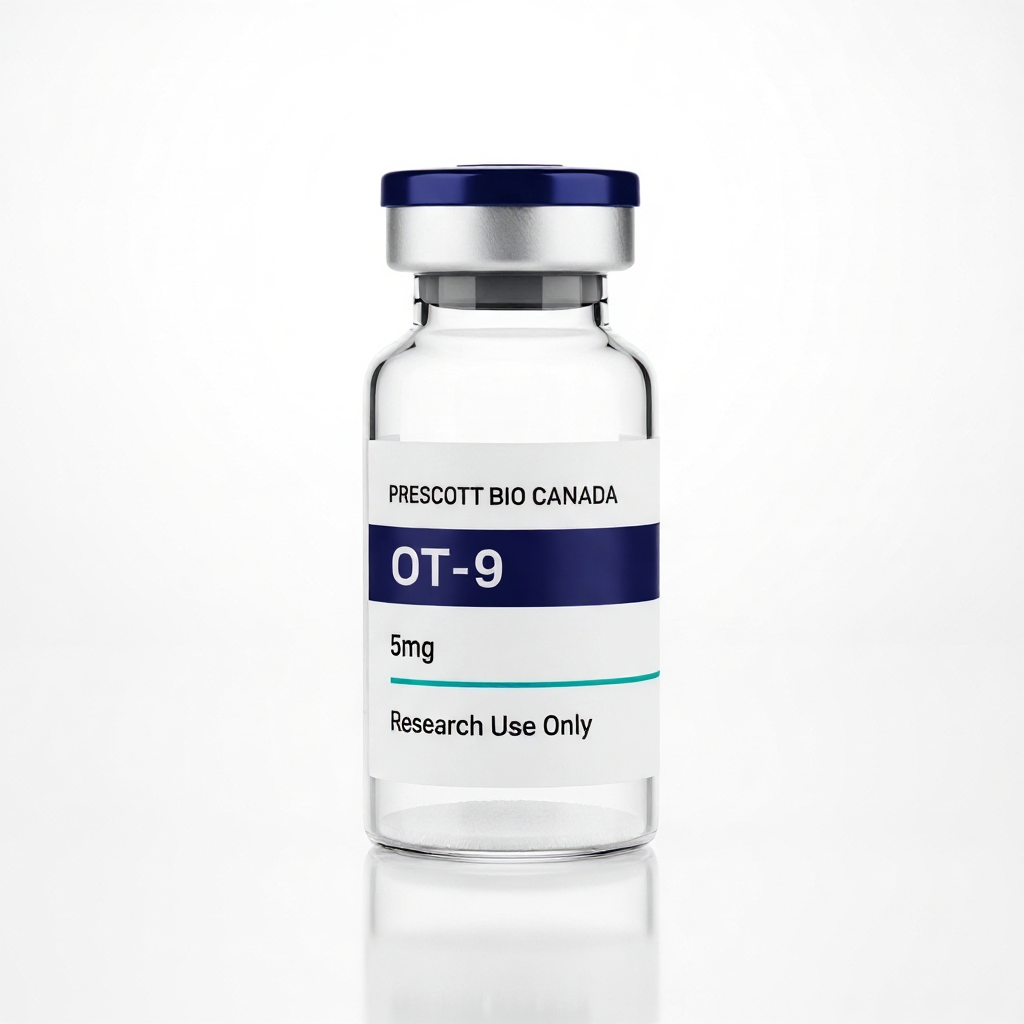
Description
Chemical Identity
Nonapeptide OT-9 is a synthetic cyclic nonapeptide with the molecular formula C43H66N12O12S2 and a molecular weight of 1007.19 Da (CAS number 50-56-6). The amino acid sequence is CYIQNCPLG-NH2, featuring an intramolecular disulfide bond between Cys1 and Cys6 that creates the characteristic cyclic structure essential for receptor binding and biological activity.
Nonapeptide OT-9 is widely studied in research on social behavior, reproductive physiology, and neuroendocrine function. The compound, also known as oxytocin in the research literature, is produced endogenously by magnocellular neurons in the hypothalamic supraoptic and paraventricular nuclei. It has been used in clinical settings for decades and is approved for labor induction and postpartum hemorrhage management.
| Property | Value |
|---|---|
| Molecular Formula | C43H66N12O12S2 |
| Molecular Weight | 1007.19 Da |
| CAS Number | 50-56-6 |
| Sequence | CYIQNCPLG-NH2 (disulfide bond Cys1-Cys6) |
| Research Status | Approved (reproductive medicine) |
Research Overview
Nonapeptide OT-9 has been extensively investigated across clinical and preclinical research in reproductive physiology, social neuroscience, behavioral research, and neuroendocrine function. The primary mechanism involves activation of the oxytocin receptor (OXTR), a Gq/11-coupled GPCR that stimulates phospholipase C, generating IP3-mediated calcium release from intracellular stores. In uterine smooth muscle, this calcium elevation drives myometrial contractions. In the central nervous system, oxytocin receptor activation modulates social bonding, trust, anxiety, and stress responses.
Research on Nonapeptide OT-9 spans an unusually broad range of physiological systems, reflecting the widespread expression of oxytocin receptors in the brain, uterus, mammary gland, cardiovascular system, and immune cells.
Key areas of published research include:
- Reproductive Physiology: Nonapeptide OT-9 is established as a critical mediator of uterine contractions during labor and milk ejection during lactation. It has decades of clinical use for labor induction and management of postpartum hemorrhage.
- Social Behavior and Neuroscience: Intranasal administration studies have investigated the effects on social cognition, trust, empathy, pair bonding, and anxiety reduction. Research has explored potential applications in autism spectrum disorder and social anxiety.
- Stress and Anxiety: Nonapeptide OT-9 has been shown to attenuate HPA axis stress responses and reduce anxiety-related behaviors in preclinical models, with the amygdala being a key site of action for anxiolytic effects.
Nonapeptide OT-9 has regulatory approval for obstetric indications. Research-grade material is available for preclinical studies in additional application areas.
Specifications
All Nonapeptide OT-9 supplied by Prescott Bio Canada is manufactured to research-grade standards.
| Specification | Detail |
|---|---|
| Purity | >98% (HPLC) |
| Form | Lyophilized powder |
| Appearance | White to off-white powder |
| Storage (lyophilized) | -20°C, protected from light |
| Storage (reconstituted) | 2-8°C, use within 30 days |
| Solubility | Soluble in bacteriostatic water, sterile water, or normal saline |
Each vial is accompanied by a Certificate of Analysis (COA) documenting purity, identity, and endotoxin testing.
Research Applications
Nonapeptide OT-9 is supplied exclusively for in vitro and in vivo laboratory research. Published experimental applications include:
- Oxytocin receptor signaling and GPCR pharmacology studies
- Social behavior and neuroscience research
- Reproductive physiology and uterine contractility studies
- Stress response and HPA axis modulation research
- Anxiety and social cognition research models
- Pair bonding and attachment behavior studies
Researchers should consult the primary literature and institutional review protocols before designing experiments with Nonapeptide OT-9.
Storage and Handling
Lyophilized powder: Store at -20°C in the original sealed vial, protected from light and moisture. Under these conditions, Nonapeptide OT-9 maintains stability for up to 24 months. The disulfide bond between Cys1 and Cys6 is essential for biological activity.
Reconstituted solution: Reconstitute with bacteriostatic water or sterile water. Store reconstituted Nonapeptide OT-9 at 2-8°C and use within 30 days. Avoid repeated freeze-thaw cycles.
Handling precautions: This product is intended for research use only (RUO). Not for human or veterinary diagnostic or therapeutic use. Handle using standard laboratory safety practices including appropriate PPE.