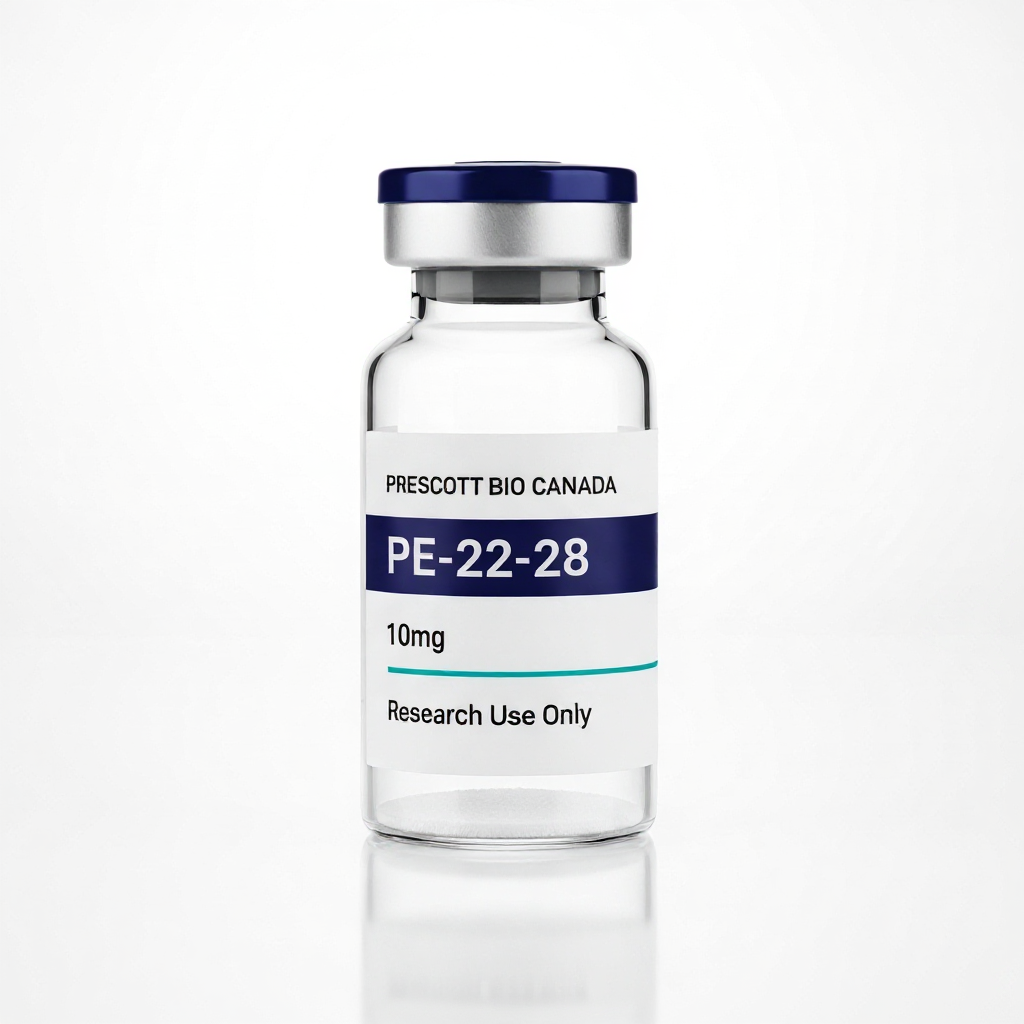
Description
Chemical Identity
PE-22-28 is a synthetic heptapeptide with the molecular formula C35H55N11O9 and a molecular weight of approximately 773.89 Da. The amino acid sequence is Gly-Val-Ser-Trp-Gly-Leu-Arg (GVSWGLR), corresponding to positions 22-28 of the sortilin propeptide. PE-22-28 was designed from analysis of spadin blood degradation products as the minimal active fragment retaining TREK-1 potassium channel blocking activity, with substantially improved potency and metabolic stability compared to the parent spadin peptide.
PE-22-28 is also known by the following designation: Spadin analog.
| Property | Value |
|---|---|
| Molecular Formula | C35H55N11O9 |
| Molecular Weight | 773.89 Da |
| CAS Number | 1801959-12-5 |
| Sequence | GVSWGLR (7 aa) |
| Research Status | Preclinical |
Research Overview
PE-22-28 has been investigated in preclinical models of depression, neurogenesis, and TREK-1 potassium channel pharmacology. The primary mechanism of action involves potent and selective blockade of TREK-1 (TWIK-Related K+ Channel 1) two-pore domain potassium channels with an IC50 of 0.12 nM, representing approximately 300-500 times greater affinity than the parent spadin compound. TREK-1 channels regulate neuronal excitability, and their genetic deletion in mice produces an antidepressant phenotype, establishing TREK-1 as a validated target for mood regulation research.
Key areas of published research include:
- Antidepressant-Like Effects: In rodent behavioral models, PE-22-28 reduced immobility time in the forced swimming test at levels comparable to SSRIs, demonstrating antidepressant-like activity. The novelty suppressed feeding test, which is sensitive to chronic but not acute antidepressant treatment, also showed positive effects with PE-22-28, suggesting engagement of neuroplastic mechanisms rather than simple locomotor stimulation.
- Rapid Neurogenesis: One of the most notable findings for PE-22-28 is its ability to induce hippocampal neurogenesis after only 4 days of treatment, a significantly faster onset than SSRIs which typically require 2-3 weeks to promote neurogenesis. This rapid neurogenic effect may underlie the behavioral improvements observed in preclinical depression models.
- Improved Pharmacological Profile: PE-22-28 demonstrates a duration of action of approximately 23 hours compared to 7 hours for parent spadin, substantially improving its practical utility as a research tool. The shortened 7-amino acid sequence (versus 17 for spadin) also improves metabolic stability and facilitates synthesis.
The current evidence base consists of preclinical in vitro and rodent behavioral studies. No human clinical trials have been conducted. PE-22-28 represents a novel mechanism of antidepressant action distinct from monoamine-based approaches.
Specifications
All PE-22-28 supplied by Prescott Bio Canada is manufactured to research-grade standards.
| Specification | Detail |
|---|---|
| Purity | >98% (HPLC) |
| Form | Lyophilized powder |
| Appearance | White to off-white powder |
| Storage (lyophilized) | -20°C, protected from light |
| Storage (reconstituted) | 2-8°C, use within 30 days |
| Solubility | Soluble in bacteriostatic water, sterile water, or normal saline |
Each vial is accompanied by a Certificate of Analysis (COA) documenting purity, identity, and endotoxin testing.
Research Applications
PE-22-28 is supplied exclusively for in vitro and in vivo laboratory research. Published experimental applications include:
- Investigation of TREK-1 two-pore domain potassium channel pharmacology and structure-activity relationships
- Study of hippocampal neurogenesis induction and its relationship to antidepressant behavioral effects
- Examination of non-monoaminergic antidepressant mechanisms and ion channel-based mood regulation
- Research into sortilin propeptide-derived peptide biology and neuronal excitability modulation
Researchers should consult the primary literature and institutional review protocols before designing experiments with PE-22-28.
Storage and Handling
Lyophilized powder: Store at -20°C in the original sealed vial, protected from light and moisture. Under these conditions, PE-22-28 maintains stability for up to 24 months.
Reconstituted solution: Reconstitute with bacteriostatic water or sterile water to the desired concentration. Store reconstituted PE-22-28 at 2-8°C and use within 30 days. Avoid repeated freeze-thaw cycles.
Handling precautions: This product is intended for research use only (RUO). Not for human or veterinary diagnostic or therapeutic use. Handle using standard laboratory safety practices including appropriate PPE.