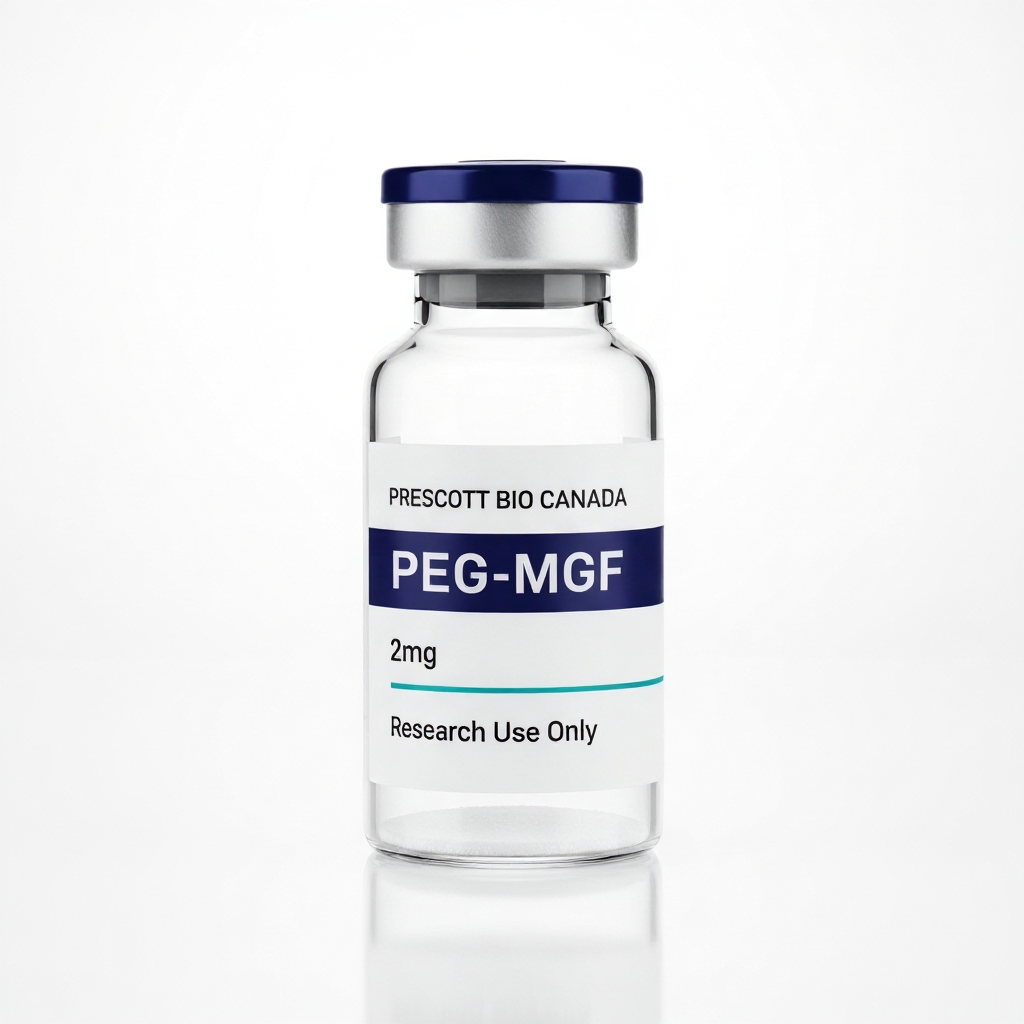
Description
Chemical Identity
PEG-MGF (PEGylated Mechano Growth Factor) is a modified form of the 24-amino acid MGF peptide conjugated to a polyethylene glycol (PEG) polymer, with an approximate molecular weight of 5000 Da. The base peptide sequence is YQPPSTNKNTKSQRRKGSTFEEHK, corresponding to the unique C-terminal E-domain of the IGF-1Ec splice variant, with PEG conjugation providing significantly extended biological half-life compared to unmodified MGF.
PEGylation is a well-established pharmaceutical strategy that reduces proteolytic degradation, decreases renal clearance, and extends circulation time. In the case of PEG-MGF, this modification addresses the extremely short half-life of native MGF peptide, enabling sustained receptor engagement in research applications.
| Property | Value |
|---|---|
| Base Peptide Formula | C121H200N42O39 + PEG |
| Molecular Weight | ~5000 Da (peptide + PEG) |
| Base Sequence | YQPPSTNKNTKSQRRKGSTFEEHK-PEG |
| Modification | Polyethylene glycol conjugation |
| Research Status | Preclinical |
Research Overview
PEG-MGF has been investigated in preclinical research examining extended-duration muscle repair signaling and satellite cell activation. The proposed mechanism is identical to native MGF — activation of muscle satellite cells and initiation of proliferative repair responses — but with the PEGylation providing a sustained pharmacokinetic profile that better supports research requiring prolonged exposure.
The rationale for PEG-MGF development arose from the observation that unmodified MGF has an extremely short half-life in vivo, limiting its utility in research protocols requiring sustained exposure to study downstream effects of satellite cell activation and muscle repair signaling.
Key areas of published research include:
- Extended Satellite Cell Activation: PEG-MGF is studied for its ability to provide sustained stimulation of muscle satellite cells compared to the rapid clearance of unmodified MGF, enabling investigation of time-dependent muscle repair processes.
- PEGylation Pharmacology: PEG-MGF serves as a model for studying how PEG conjugation affects peptide pharmacokinetics, tissue distribution, and biological activity in growth factor applications.
- Muscle Regeneration Research: Preclinical studies have examined PEG-MGF in muscle injury and regeneration models, building on the mechanistic foundation established for the parent MGF peptide.
PEG-MGF remains a preclinical research compound with no regulatory approvals.
Specifications
All PEG-MGF supplied by Prescott Bio Canada is manufactured to research-grade standards.
| Specification | Detail |
|---|---|
| Purity | >98% (HPLC) |
| Form | Lyophilized powder |
| Appearance | White to off-white powder |
| Storage (lyophilized) | -20°C, protected from light |
| Storage (reconstituted) | 2-8°C, use within 30 days |
| Solubility | Soluble in bacteriostatic water, sterile water, or normal saline |
Each vial is accompanied by a Certificate of Analysis (COA) documenting purity, identity, and endotoxin testing.
Research Applications
PEG-MGF is supplied exclusively for in vitro and in vivo laboratory research. Published experimental applications include:
- Extended-duration muscle satellite cell activation research
- PEGylation pharmacokinetics and growth factor modification studies
- Muscle injury and regeneration mechanism research
- Comparative studies with unmodified MGF examining duration-dependent effects
- IGF-1 splice variant biology and E-domain signaling studies
Researchers should consult the primary literature and institutional review protocols before designing experiments with PEG-MGF.
Storage and Handling
Lyophilized powder: Store at -20°C in the original sealed vial, protected from light and moisture. Under these conditions, PEG-MGF maintains stability for up to 24 months.
Reconstituted solution: Reconstitute with bacteriostatic water or sterile water to the desired concentration. Store reconstituted PEG-MGF at 2-8°C and use within 30 days. Avoid repeated freeze-thaw cycles.
Handling precautions: This product is intended for research use only (RUO). Not for human or veterinary diagnostic or therapeutic use. Handle using standard laboratory safety practices including appropriate PPE.