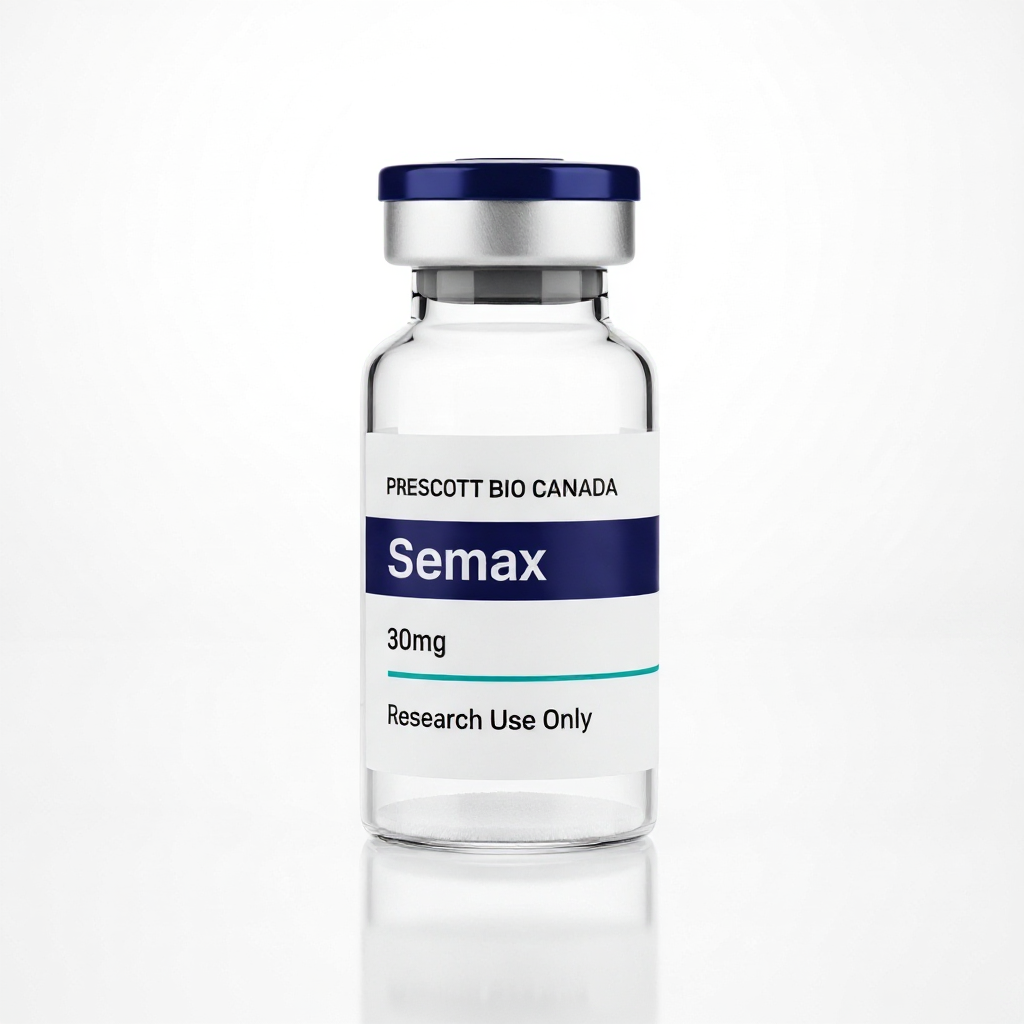
Description
Chemical Identity
Semax analytical reference compound. Molecular weight 813.93 Da. Also known as: ACTH(4-7)-PGP, Semax Peptide. Research status: Approved.
Research Overview
Semax is a synthetic heptapeptide derived from the ACTH(4-7) fragment with a C-terminal Pro-Gly-Pro extension for metabolic stability. It is approved in Russia for treatment of stroke, cognitive disorders, and optic nerve disease, and has been studied for neurotrophic factor upregulation including BDNF and NGF. Unlike most peptides covered on this site, Semax has decades of clinical use in Russia, though it lacks FDA approval or EMA authorization.
Semax’s mechanism of action is multifaceted and involves several converging pathways in the central nervous system.
The most well-characterized mechanism is the upregulation of brain-derived neurotrophic factor (BDNF) and nerve growth factor (NGF) expression. Research by Dolotov et al. (2006) demonstrated that a single intranasal dose of Semax (50 mcg/kg) produces a 1.4-fold increase in BDNF protein levels and a 1.6-fold increase in trkB tyrosine phosphorylation in the rat hippocampus. At the mRNA level, exon III BDNF showed a 3-fold increase and trkB mRNA a 2-fold increase.
Semax’s primary approved indication in Russia is the treatment of acute ischemic stroke and stroke recovery. Clinical investigations by Myasoedova et al. (1999) demonstrated that Semax at doses of 100-150 mcg/kg displays angioprotective, antihypoxic, and neurotrophic activity. The drug shifts neuromediatory balance toward anti-inflammatory agents (IL-10, TNF-alpha modulation) while reducing pro-inflammatory markers (IL-8, CRP) during acute ischemic stroke recovery.
Key published studies on Semax include: “The peptide semax affects the expression of genes related to the immune and vascular systems in rat brain focal ischemia: genome-wide transcriptional analysis” (BMC Genomics, 2014); “Comparison of the temporary dynamics of NGF and BDNF gene expression in rat hippocampus, frontal cortex, and retina under Semax action” (Journal of Molecular Neuroscience, 2010); “Semax and Pro-Gly-Pro activate the transcription of neurotrophins and their receptor genes after cerebral ischemia” (Cellular and Molecular Neurobiology, 2009). These findings should be interpreted within the context of the experimental models and conditions described in each publication.
Research Context
Semax is a synthetic heptapeptide analog of the adrenocorticotropic hormone (ACTH) fragment 4-7, extended at the C-terminus with a Pro-Gly-Pro (PGP) tripeptide motif. Its full amino acid sequence is Met-Glu-His-Phe-Pro-Gly-Pro. Developed at the Institute of Molecular Genetics of the Russian Academy of Sciences beginning in the 1980s, Semax represents one of the most extensively studied nootropic peptides to emerge from Russian pharmaceutical research.
Semax occupies a unique position in the peptide landscape. It is approved as a pharmaceutical product in Russia and several Commonwealth of Independent States (CIS) countries, where it is prescribed for ischemic stroke recovery, cognitive impairment, and optic nerve diseases. It is listed on the Russian List of Vital and Essential Drugs. However, it has never been submitted for regulatory approval in Western markets and remains an unapproved research chemical in the United States, European Union, and most other countries.
The development of Semax began with the observation that ACTH fragments, particularly the 4-10 sequence (Met-Glu-His-Phe-Arg-Trp-Gly), possess nootropic and neuroprotective properties independent of the hormone’s adrenocortical effects. The ACTH(4-7) fragment (Met-Glu-His-Phe) was identified as the minimal sequence retaining cognitive activity. However, this tetrapeptide has an extremely short half-life in vivo due to rapid degradation by aminopeptidases and carboxypeptidases.
Specifications
| Sequence | Met-Glu-His-Phe-Pro-Gly-Pro |
| Molecular Weight | 813.93 Da |
| Molecular Formula | C37H51N9O10S |
| CAS Number | 80714-61-0 |
| Purity | >=98% (HPLC) |
| Appearance | White to off-white lyophilized powder |
| Format | Lyophilized powder, sterile filtered |
| Solubility | Soluble in bacteriostatic water, sterile water, or normal saline |
| Storage | Store at -20°C (lyophilized). Reconstituted: 2-8°C, use within 30 days |
| Shipping | Ambient temperature (stable in lyophilized form) |
Each lot is accompanied by a Certificate of Analysis (COA) documenting purity, identity, and endotoxin testing results.
Research Applications
Semax reference compound has been documented in the published scientific literature across the following in vitro and preclinical research areas:
- Neurotrophic Factor Upregulation
- Dopaminergic and Serotoninergic Modulation
- Neuroprotective and Anti-Inflammatory Effects
- Ischemic Stroke
- Cognitive Disorders and Nootropic Use
- Optic Nerve Disease
Researchers are advised to consult the primary literature for detailed experimental protocols, concentrations, and conditions relevant to their specific area of investigation involving Semax.
Storage and Handling
Semax is supplied as a lyophilized powder and should be stored at -20°C upon receipt for long-term stability. Protect from light, moisture, and repeated temperature fluctuations. Allow the sealed vial to equilibrate to room temperature before opening to prevent condensation and moisture absorption.
For reconstitution, add sterile water or an appropriate buffer slowly along the vial wall to avoid foaming. Gently swirl to dissolve — do not vortex. Reconstituted Semax solutions should be stored at 2-8°C and used within 30 days. Aliquoting is recommended to minimize freeze-thaw cycles. Consult the Safety Data Sheet (SDS) for detailed handling and disposal guidance.
For laboratory research use only (in vitro). Not for human or animal use. Not for diagnostic, therapeutic, or clinical purposes. Semax is supplied as an analytical reference compound for use by qualified research personnel at accredited institutions. Prescott Bio Canada does not provide guidance on administration, dosing, or use in living organisms.