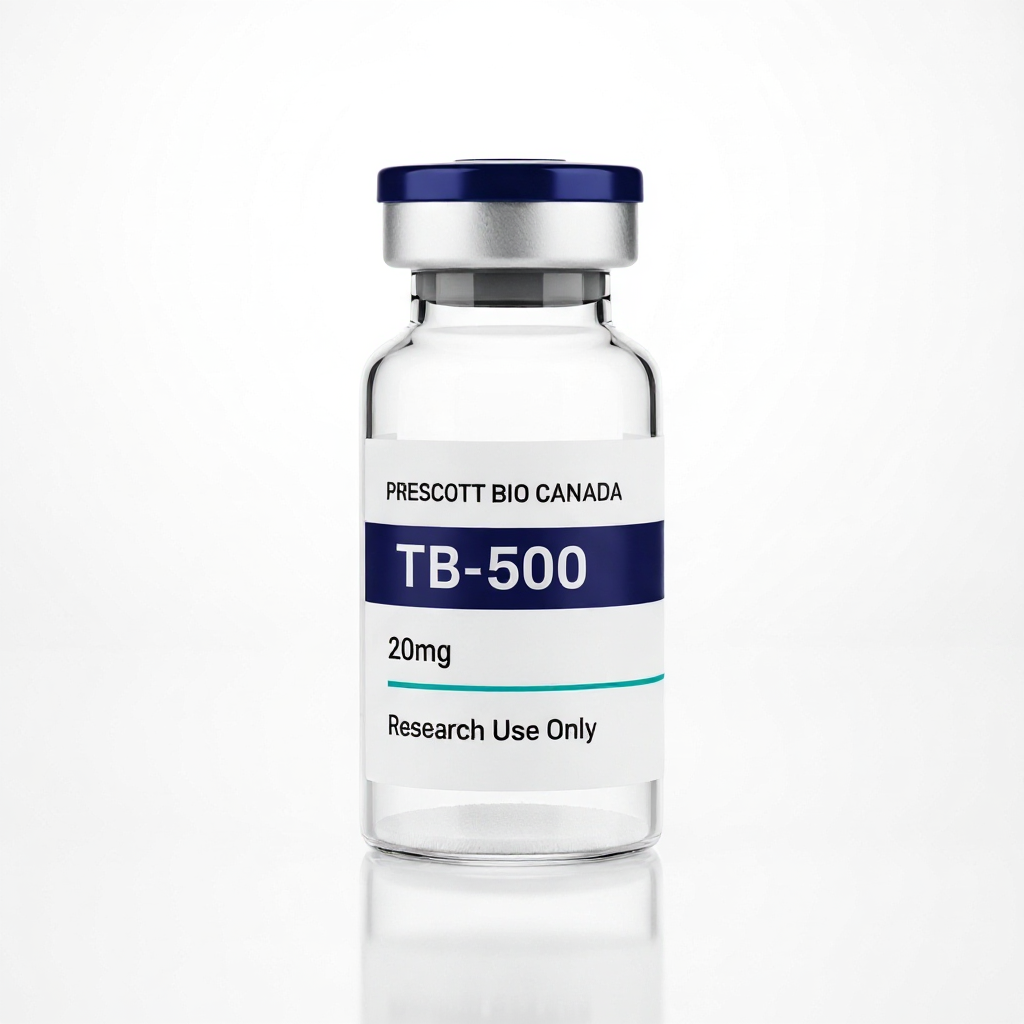
Description
Chemical Identity
TB500 is a synthetic version of Thymosin Beta-4 (Tβ4), a naturally occurring 43-amino acid peptide present in virtually all human and animal cells, with the molecular formula C212H350N56O78S and a molecular weight of approximately 4963.44 Da. Originally isolated from calf thymus tissue, Thymosin Beta-4 is encoded by the TMSB4X gene and is one of the most abundant intracellular peptides in mammalian biology. The amino acid sequence is Ac-SDKPDMAEIEKFDKSKLKKTETQEKNPLPSKETIEQEKQAGES.
TB500 is also known by the following designations: Thymosin Beta-4, TB-500, Timbetasin, Tβ4.
| Property | Value |
|---|---|
| Molecular Formula | C212H350N56O78S |
| Molecular Weight | 4963.44 Da |
| CAS Number | 77591-33-4 |
| Sequence | Ac-SDKPDMAEIEKFDKSKLKKTETQEKNPLPSKETIEQEKQAGES |
| Research Status | Phase 2 / Phase 3 (ophthalmic) |
Research Overview
TB500 has been investigated in preclinical and clinical studies spanning wound healing, ophthalmic repair, cardiac protection, and anti-inflammatory applications. The primary mechanism of action involves G-actin sequestration through a conserved LKKTET binding motif, regulating cytoskeletal dynamics to promote cell migration, angiogenesis, and tissue repair. TB500 also exerts anti-inflammatory effects through inhibition of NF-κB signaling and demonstrates anti-fibrotic properties by reducing myofibroblast activity.
Key areas of published research include:
- Dermal Wound Healing: In preclinical models, topical or systemic TB500 administration increased re-epithelialization by 42% at 4 days and 61% at 7 days over controls in full-thickness wound models. Phase II clinical trials in venous stasis ulcers demonstrated healing acceleration of nearly one month in treatment responders, with efficacy observed across diabetic, aged, and steroid-impaired wound models.
- Ophthalmic Applications: The clinical formulation RGN-259 (0.1% Thymosin Beta-4 ophthalmic solution) advanced through Phase II and Phase III clinical trials for neurotrophic keratopathy. The Phase III trial demonstrated promoted corneal healing and improved ocular comfort scores with a favorable safety profile. Phase II data showed a 35.1% reduction in ocular discomfort and 59.1% reduction in corneal fluorescein staining versus controls.
- Cardiac Protection: In preclinical models of coronary artery ligation, systemic TB500 administration improved left ventricular function, reduced infarct size, and decreased cardiac fibrosis. These cardioprotective effects were mediated through integrin-linked kinase (ILK) and Akt-mediated cell survival pathways, with evidence of epicardial progenitor cell reactivation.
The evidence base for TB500 includes Phase I-III clinical trials for ophthalmic indications and Phase II data for dermal wound healing. Preclinical evidence in cardiac and musculoskeletal models is substantial, though large-scale human cardiac trials have not been completed.
Specifications
All TB500 supplied by Prescott Bio Canada is manufactured to research-grade standards.
| Specification | Detail |
|---|---|
| Purity | >98% (HPLC) |
| Form | Lyophilized powder |
| Appearance | White to off-white powder |
| Storage (lyophilized) | -20°C, protected from light |
| Storage (reconstituted) | 2-8°C, use within 30 days |
| Solubility | Soluble in bacteriostatic water, sterile water, or normal saline |
Each vial is accompanied by a Certificate of Analysis (COA) documenting purity, identity, and endotoxin testing.
Research Applications
TB500 is supplied exclusively for in vitro and in vivo laboratory research. Published experimental applications include:
- Investigation of actin dynamics and cell migration mechanisms in wound healing models
- Assessment of angiogenic and anti-fibrotic responses in tissue injury paradigms
- Study of cardioprotective signaling through ILK-Akt pathways in ischemic models
- Evaluation of corneal epithelial repair and anti-inflammatory responses in ophthalmic research
- Analysis of NF-κB-mediated inflammatory modulation in chronic wound environments
Researchers should consult the primary literature and institutional review protocols before designing experiments with TB500.
Storage and Handling
Lyophilized powder: Store at -20°C in the original sealed vial, protected from light and moisture. Under these conditions, TB500 maintains stability for up to 24 months.
Reconstituted solution: Reconstitute with bacteriostatic water or sterile water to the desired concentration. Store reconstituted TB500 at 2-8°C and use within 30 days. Avoid repeated freeze-thaw cycles.
Handling precautions: This product is intended for research use only (RUO). Not for human or veterinary diagnostic or therapeutic use. Handle using standard laboratory safety practices including appropriate PPE.